
WHAT WE MEAN BY «UFOLOGIST» (The 3 Forms of Resistance Among UFO Participants) – By Carlos Ferguson
This article was NOT created using AI (artificial intelligence), with the possible exception of an image or two. All of our material is produced entirely based on data and statistical records. Those who cannot provide records or a documented history may well need AI to generate their texts—but that is not the case for us.
INTRODUCTION
For years, many have attempted to define what it means to be a «ufologist.»
Some detractors do so in a mocking or derogatory way, claiming that there is no single definition that can encompass what it means to be a «ufologist.»
Definitions found online—such as those on Wikipedia or, more recently, those provided by AI—describe a ufologist as a person who:
“…is dedicated to the investigation of unidentified flying objects (UFOs) and anomalous aerial phenomena. This work focuses on the analysis of sightings, videos, photographs, and testimonies—often seeking an extraterrestrial origin—though mainstream science classifies it as a pseudoscience.” (end of quote)
The inclusion of the phrase «often»—referring to the belief among ufologists that these phenomena have an extraterrestrial origin—does not always align with reality.
Beyond this, we prefer to adopt the perspective of the notable and well-remembered researcher Willy Smith. In his excellent work, Panorama del fenómeno Ovni (Overview of the UFO Phenomenon), written in the early 1990s, he stated:
“Rather than referring to those interested in the UFO phenomenon as ‘ufologists’—a term that may evoke imprecise mental images for the reader—we prefer to use the term ‘practitioners,’ which encompasses the broad spectrum of people drawn to the subject. Their motivations and approaches vary significantly…” (QUOTE 1)
Smith argued that it was no longer sufficient to categorize ufologists into just two groups (those who live for the phenomenon versus those who make a living from the phenomenon); rather, it was necessary to expand these categories.
He proposed six, which we briefly summarize here:
Categories of UFO-related participants, as proposed by Dr. Willy Smith:
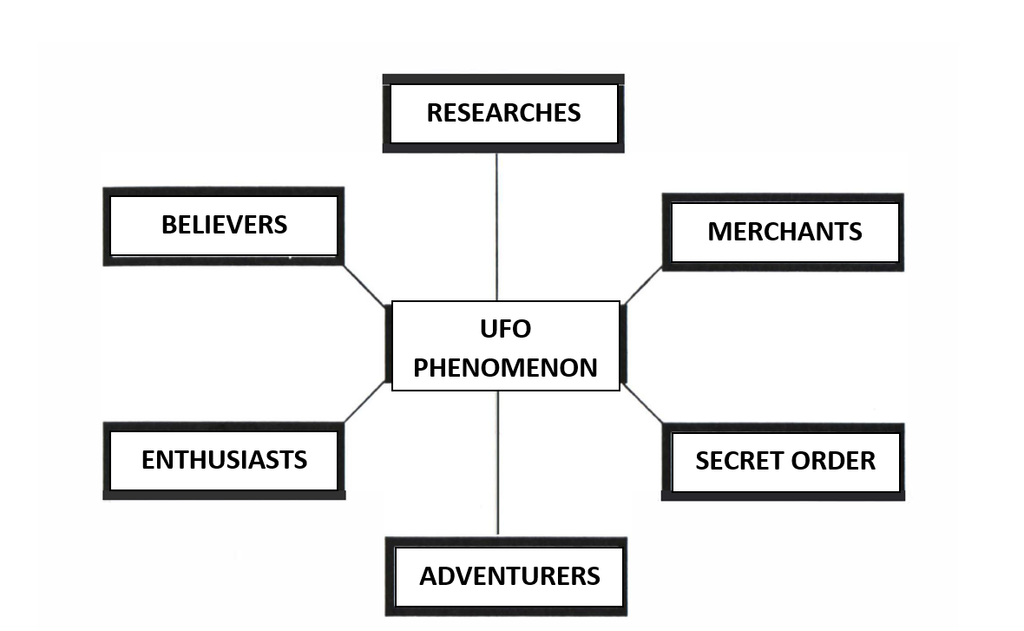
1 – The Merchants = Those whose involvement is driven solely by economic gain.
2 – The Researchers = Those with a genuine interest in the phenomenon. They come from all walks of life and expect no reward whatsoever. Unfortunately, they are few in number and sometimes come into conflict with UFO organizations. At times, they pursue unconvincing hypotheses—not out of bad faith, but due to a lack of knowledge when venturing into areas outside their own training and experience. If Ufology is to survive as a legitimate discipline, it will be thanks to the efforts and dedication of the individuals who make up this group, working quietly in the background.
3 – The Adventurers = They are not interested in the reality of the UFO phenomenon, but rather in the opportunity to gain fame, power, and glory. They are never wrong, and they take offense when criticized or caught in an error. These are the “political” ufologists.
4 – The Enthusiasts = They have a vivid interest in the subject of UFOs, which opens up all sorts of exciting and intriguing possibilities within their otherwise routine and dull lives. They are the primary buyers of UFO books and magazines; they readily believe tales about extraterrestrials, willingly accept the supposed messages these beings convey, and easily part with their money for the benefit of those selling such material.
5 – The Believers = Their defining characteristic is blindly following the directives of others, having accepted the basic premises of a case or hypothesis as gospel. Rational thought has been entirely abandoned, and their reaction toward those who hold dissenting views is belligerent. Discussion is neither necessary nor acceptable to them, as their conviction that they possess the absolute truth is unshakable.
6 – The Secret Academy = These are typically individuals from within the scientific community—few in number, yet forming an important elite of serious researchers who consider the subject significant enough to warrant thorough investigation. However, their professional obligations and the need to safeguard their careers prevent them from participating actively. For now, they remain mere observers, following developments closely and quietly. As the years go by, these individuals increasingly enter the public arena; and, given their training and potential influence, one expects that their growing participation will help transform ufology into an acceptable discipline.

Thirty-five years have passed since Smith’s remarks, and while his work remains as relevant as ever, we can now add new trends to those he originally identified.
As Smith rightly pointed out, there is an endless array of variations and characteristics—not all of which are necessarily compatible—making the use of the blanket term «ufologist» a conceptual error.
An ideal, foundational definition involves the practical and theoretical study and investigation of UFO reports, often with the intent of disseminating findings through some form of media or communication channel.
Both field research and theoretical work require a vast and complex body of knowledge at every level.
In fact, there have been excellent field investigators who never delved into the theoretical side (such as statistics or the study of recurring patterns).
Conversely, there have been brilliant theorists and analysts who never engaged in the direct investigation of a specific report.
While all of these roles can fall under the broad umbrella of being a «ufologist,» it is useful to make further distinctions.
ANY GENERALIZATION ABOUT «UFOLOGISTS» IS FLAWED
Anyone who attempts to portray the «ufologist» as a monolithic category is simply being dishonest.
Some use such generalizations to disparage honest individuals, lumping them together with those who have ulterior or dubious motives.
Smith referred to them as «practitioners»—a term that remains perfectly appropriate. We also refer to them as «participants.»
However, it is important to distinguish this from a mere hobby.
A hobby is defined as:
«An activity pursued for pleasure and enjoyment during one’s free time, without any obligation or economic objective.»
Perhaps many of us start out this way. And some today—even while considering themselves «participants» or «researchers»—might, in reality, simply be engaging in a hobby.
One can approach any subject from an infinite number of angles and perspectives—some productive, others not. (QUOTE 2)
Since Ufology is not a professional field, we only engage in it during our spare time, outside of our jobs and other commitments. It is, in many ways, akin to a hobby.
However, for the person writing this, involvement represents something more than just a spare-time pastime.

VARIATIONS IN PARTICIPATION
Beyond the excellent simplification that Dr. Smith had developed, things have become significantly more complex today.
Within the broad category we call “Ufological Participants,” we find a vast array of tendencies and activities. These span the entire social spectrum and, in many cases, involve highly diverse interests.
We can observe individuals who engage in:
Field and theoretical research.
Field and theoretical research, as well as the dissemination of information.
Field research, without theoretical work or dissemination.
Field research, without theoretical work, but with dissemination.
Theoretical (non-field) research, with dissemination.
Theoretical (non-field) research, without dissemination.
Dissemination only—lacking both field and theoretical research—which may occasionally consist of reliable information, but more often takes the form of sensationalist news.
Ad-hoc groups formed for the purpose of «UFO hunting.»
Activities with purely commercial motives, sometimes subtly disguised.
Theorists who lack raw data or any study of consistent patterns (empirical data and case studies).
Those seeking «contact» experiences (whether by promoting belief systems or conducting experiments without examining variables).
Individuals who enjoy gatherings merely to discuss news and gossip, without ever going beyond that.
People active online driven by a desire for notoriety, prioritizing their own image over the phenomenon itself and its study.
The occasional «mole» or infiltrator—we encountered several during our own time in the field, and some are still active today.
Participants who present personal interpretations as if they were universally accepted truths (for example, claiming the existence of behavioral patterns that do not actually exist, or citing alleged «declassifications» that never took place in Argentina).
«Revisionists» of Ufology (often relying on distorted or false data).
Those focused on «UFO-themed» social gatherings—such as dining events—where the social/gastronomic aspect becomes the primary focus rather than the research itself.
«Experts» who cite obsolete or manipulated statistics—data known only to them and never published—thereby promoting non-existent or purely fanciful patterns. Journalists who, from time to time, seek to use UFO-related material to attempt “new approaches,” aiming to provide “significant” new twists. They often present themselves as “expert interviewees,” relying on all manner of accounts that have undergone absolutely no vetting. In short: they focus solely on narratives that have never been fact-checked.
Pseudo-skeptics who criticize ufologists, yet “investigate” in laughable ways to offer “new explanations” for various cases.
Those who disseminate “articles” generated by AI.
Individuals who take partial data and manipulate it to serve their own promotional agendas (for example, by overgeneralizing aspects of a case, or failing to cite the prior work of others).
Occasional storytellers.
Among others.
As we can see, the spectrum is broad, and one could surely identify many more categories.
Furthermore, some individuals exhibit more than one of these traits—though only a few possess genuine good intentions, a proactive spirit, and sound judgment.
Others operate under the belief that “investigation” can be conducted without any methodology—perhaps merely by conducting an interview—or they may be driven by spurious or undisclosed motives.
Ultimately, what we see is a wide, multicolored spectrum; it is impossible to pigeonhole the entire field of Ufology into a single, monolithic category.

INITIAL RESISTANCE AMONG UFO ENTHUSIASTS
Throughout our years of involvement in ufology—now spanning more than five decades—we have observed clear, collective patterns, a perspective gained from our 17 years coordinating the Argentine UFO Research Network (RAO).
Long ago, the eminent Jacques Vallée spoke of certain forms of resistance among ufologists in general.
We might define “resistance” as the “capacity to endure, tolerate, or oppose something.”
In the context of the Argentine UFO community, “opposition” is perhaps the most fitting term.
During the 1980s and 90s, most of those involved in the field were either field investigators or theorists, with only limited means of disseminating their work. Such dissemination typically took the form of small-scale, printed bulletins—often with a circulation of just 20 or 30 copies, if one was lucky—or through presentations at conferences and meetings.
Presenting one’s work or research carried a sense of responsibility, especially given the presence of prominent, highly respected figures in the field. Despite potential shortcomings, there was a commitment to rigor when presenting information.
The writings from that era are incomparable to those produced today; they often included high-quality supplementary data and even annual case compilations—material that many of today’s critics of ufology scramble to acquire whenever it surfaces for sale.

Attending a conference to give a presentation was not a task for just anyone, nor was it something done haphazardly—except, perhaps, in venues that welcomed charlatans or the delusional. It was an act of putting oneself out there—not only in terms of the investigative work conducted on a specific case or report, but also in terms of facing one’s peers. There was, for the most part, very little room for total improvisation.
Generally, such work was carried out by individuals or small groups (no more than two or three people).
Yet, throughout those years, we were never able to reach an agreement to take more ambitious steps forward. Collective projects were met with resistance by a majority who viewed neighboring groups with suspicion; they were never willing to adapt or adopt even a simple investigative protocol.
Hynek and Smith had already noted this during their visits to Argentina. Alan Hendry (also of CUFOS) had pointed out:
“Unlike in the United States, UFO groups (in Argentina) are numerous but have few members—in some cases, extremely few. This tendency has been attributed to the individualistic nature of Argentines, who prefer to work on their own.” (Alan Hendry, 1981)
That was the first form of resistance: a refusal—even while maintaining their own individuality—to join any collective initiative aimed at advancing data collection and research.

THE SECOND FORM OF RESISTANCE AMONG UFO ENTHUSIASTS
The second form emerged with the widespread adoption of the Internet.
Enthusiasts no longer needed conferences or printed newsletters to make themselves known; they began disseminating information on a massive scale, independently. The fragmentation became even more pronounced.
Driven by a desire for public visibility—and perhaps the occasional “friendly” check-in to see “what others are up to”—most people focused on creating their own individual websites or blogs, bypassing any form of collective work or study.
All attempts by those of us who sought to pool our efforts for greater progress proved futile.
What followed was a phenomenon known as “informational fragmentation.”
The atomization of the information landscape caused the audience to scatter completely, leaving no room for a “shared narrative.”
Information became segmented, giving rise to “ideological digital tribes,” while an oversaturation of data overwhelmed the capacity to process it.
As professional editors disappeared, content based on even a minimum standard of critical judgment vanished, increasingly making way for “fake news.”
Today, we remain deeply immersed in this state of atomization.

THE THIRD RESISTANCE AMONG UFO ENTHUSIASTS
As we entered the new millennium, a third «resistance» emerged—one with consequences far worse than those that came before: field research declined precipitously.
It has often been argued that Argentina’s recurring economic crises make it impossible to carry out basic research, and this is true.
Yet, even with these challenges, Argentina has always faced crises—and in earlier times, research remained the top priority. As time passed, however, everything else was pushed to the sidelines.
Public outreach expanded across countless media platforms, giving rise to new archetypes—such as the «perpetual theorists» (who frequently repurpose others’ work to lend a veneer of «novelty» to their own so-called «discoveries»).
Then there are the «storytellers»—rhetorical adventurers who, without a hint of shame, step up to the microphone posing as seasoned «experts» or brilliant minds capable of deciphering a vast array of complex topics.
They hold forth on everything, despite never having drawn from the well of personal, hands-on experience.
Today, the vast majority of content found online and on streaming platforms is saturated with these figures, who fill the space with fabricated or distorted cases and data—driven solely by a desire for exposure.
In short: they are individuals eager to provide «answers» and «discoveries»—seeking the film’s conclusion without ever having watched or experienced the movie itself.
Worst of all, many of the long-time participants who were once dedicated to research have simply given up, dismissing the subject as a relic of the past—thereby ceding the stage to a motley assortment of hucksters.
For those interested in exploring this further, please refer to my previous article on the subject (QUOTE 3).

THE NEED FOR AN INVESTIGATIVE UFOLOGY
Given the current landscape facing Ufology, there are not many alternatives.
One can either join the fray of narratives that lead to new myths, sensationalism, and the pursuit of «scoops,» or return to the fundamentals—field and theoretical research—supported by training adapted to today’s technological era.
Today, there are many advantages for Ufological research compared to what we had years ago.
For instance:
A – The distances involved have been effectively bridged by modern communication tools.
In the past, conducting an investigation—even just a few kilometers away—was a major undertaking for an independent researcher. This was especially true for cases involving UFO reports hundreds or thousands of kilometers away, where there was no one nearby to carry out an investigation. Many of us researchers funded these efforts out of our own pockets.
Argentina’s vast geography poses a challenge for research that lacks official support. When I was appointed as the first ad honorem civilian advisor to the Argentine Air Force, I proposed bringing in more researchers and launching a project that would cover many parts of the country. Unfortunately, this never materialized following a change in leadership at that office—an office that had been run for years by an incompetent individual, aided by a few covert acolytes.
B – Technical tools are invaluable. We now have many advantages that were previously unavailable.
Simply locating a lesser-known town on a map used to require an extensive search. Today, we have maps on our mobile phones, access to data about places that were once considered unreachable, and the ability to take precise measurements.
The same applies to communications. In the past, one had to figure out how to track down a witness’s landline number or contact an authority (depending on the details of the report). Sometimes, you just had to «take a chance» and head there without any prior arrangements—something we did quite often. Today, we can access the profiles of witnesses—or their relatives—almost immediately, thanks to social media.

The same applies to searching for data on astronomical or astronautical phenomena: in the past, one had to stay as up-to-date as possible using the resources available at the time (primarily books or specialized information). Today, we can instantly track the movement of satellites and balloons in real time, and access an endless array of celestial data.
In complex cases (such as those involving potential physical residue), we now have far more information on how to carry out the necessary procedures, as well as access to organizations and professionals qualified to conduct such studies.
Yet, despite all these advancements, one factor remains unchanged: the criteria used for gathering data (which is entirely different from conducting a journalistic interview).
Direct inquiry—whenever possible—remains crucial, as does the careful handling of information and data, free from the sensationalism often driven by the media. This is especially important given the tools we now have at our disposal.
However, all this technology is useless if we lack the fundamental raw material—the cases themselves—and a basic understanding of the history of Ufology in Argentina. Any approach that is incomplete or lacks a solid foundation is bound to fail.

CONCLUSION
A – Since Ufology is not a professionalized field, there is a wide disparity in the activities and intentions of its participants. This «free-for-all» environment allows for the presence of all sorts of individuals and narratives.
B – The generalization that a «ufologist» is always the same type of person is false. This has frequently been exploited by various detractors, who seek to conflate charlatans with genuine researchers. The incompetent individual who ran an official office in Argentina from 2015 to 2026 adopted this stance when dealing with the media, framing all ufologists as mere «believers in extraterrestrials» or, at best, as misinformed. This individual was supported behind the scenes by others whose arguments we have been well acquainted with for years.
C – To the more than 20 varieties of «ufologists» mentioned above, many more could be added. If there is an ideal or preferred type, it is the one characterized by greater effort, dedication, and commitment—both in field and theoretical research—aimed at making genuine progress, far removed from the pursuit of quick «scoops» or sensationalism.
D – Detractors have often claimed that it is impossible to determine the best research method. This premise is false; within the field of research methodology, there are many established parameters to follow. Certain techniques remain constant and do not become obsolete over time. Those who promote the idea that no such standards exist are often the same people who prefer a state of disarray to serve their own agendas.

EPILOGUE
If we agree that we do not yet possess a definitive case or piece of evidence to confirm specific aspects of the phenomenon, then we must rely on field and theoretical research to develop the most comprehensive picture possible. This is achieved through a rigorous investigative process, utilizing specific tools and methodologies.
Ultimately, this approach must always go beyond the scope of a mere journalistic interview. It is not merely a matter of eliciting an opinion so that “people can draw their own conclusions,” as some journalists often put it.
A true investigator must be rigorous and should not seek consensus for the sake of public appeal. It is the investigator’s own responsibility to filter information whenever necessary.
The great challenge facing those involved in ufology today is to venture into the realm of research methodology, lest the field devolve into an avalanche of rumors—producing nothing more than popular beliefs and anecdotes. Furthermore—as I noted in a previous article (CITATION 3)—we ufologists are neither psychologists, religious figures, social workers, nor journalists.
There are many enthusiasts searching for UFOs, but few—if any—who focus on developing methodologies for interviewing witnesses.
This presents a wonderful challenge: to dare to apply techniques and working methods that align as closely as possible with fundamental principles of interviewing and investigation—approaches that distinguish the work from casual, anecdotal coffee-shop chatter or a purely emotional quest.
Carlos Ferguson

The author, Carlos Ferguson, works in the educational sector in the Province of Buenos Aires (Argentina). He is also an art instructor and has been researching the UFO phenomenon for 50 years—a pursuit that began when, as a skeptic, he had a close encounter with a disc-shaped UFO at a distance of no more than 35 meters. He served as the first civilian advisor on ufology for the Argentine Air Force (from 2011 to 2017) and currently holds a similar advisory role for CRIDOVNI (within the Uruguayan Air Force), making him the first ufologist globally to have served as a consultant for the air forces of two different countries. He has completed coursework in satellite technology, remote sensing, and geographic information systems (GIS). He is the author of seven books and has compiled the most extensive collection of UFO landing cases in Argentina, with the events categorized accordingly. His research also covers cases involving pilots and UFOs in Argentina, as well as underwater objects; more recently, he has focused on the physiological and electromagnetic effects experienced by witnesses. Over the course of nearly five decades, he has delivered hundreds of lectures and contributed numerous articles, consistently applying a methodology rooted in statistical analysis. While he is no longer active within the Argentine ufology community, he maintains connections internationally.
QUOTES
QUOTE 1 = “Overview of the UFO Phenomenon,” Los practicantes – Dr. Willy Smith – Cuadernos de Ufología No. 11 – 1991
QUOTE 2 = Within the field of ufology, there are surveys, fieldwork, and theoretical studies. Today, however, much of the activity consists of various types of meetings, individuals claiming the title of “expert” or “researcher” without ever having delved deeply into the subject, the misinterpretation of statistical analyses, and the proliferation of countless theories that lack any supporting data.
QUOTE 3 = “The current state of Ufology in Argentina: an overwhelming majority of fakes and disinformation” – Carlos Ferguson – Link = https://www.carlosferguson.com.ar/current-argentine-ufological-spread-an-overwhelming-majority-of-fake-news-and-disinformation/
QUOTE 4 = “Ufologists: neither psychologists, nor religious figures, nor social workers, nor journalists” – Carlos Ferguson – Link = https://www.carlosferguson.com.ar/ufologists-neither-psychologists-nor-religious-persons-nor-social-workers-nor-journalists/