
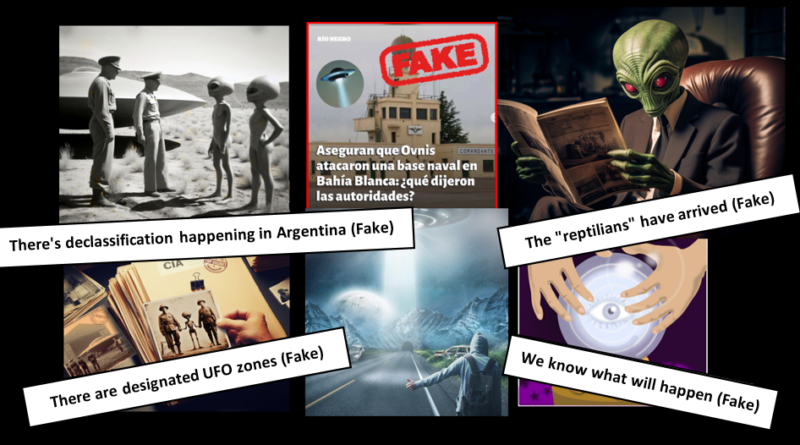
CURRENT ARGENTINE UFOLOGICAL SPREAD: AN OVERWHELMING MAJORITY OF FAKE NEWS AND DISINFORMATION
By Carlos Ferguson
This article is NOT generated using AI (artificial intelligence), except for some images. All our material is created entirely from data and statistical archives. Those who cannot display archives or historical data will likely need AI for text processing, but that is not our case.
“Post-truth appeals directly to the emotional world and dispenses with any reference to truth, events, or real facts. To provoke a predetermined conviction, establish an ideology, or create a particular state of opinion, post-truth can affirm (or distort) whatever suits it, since it doesn’t need to submit to verification of its truth or the veracity of reality. This emotional fervor is intended to silence—intentionally—any hint of rationality, even when presented in an (apparent and deceptive) rational format.” (José Benigno Freire, Professor at the Faculty of Education and Psychology, University of Navarra)
FOREWORD
In a recent article (“Ufologists: neither psychologists, nor religious figures, nor social workers, nor journalists”), I addressed the danger of post-truth narratives in ufology. (QUOTE 1)
According to the Pew Research Center publication “The Risks of the Post-Truth Society,” 60% of the population cannot recognize when a news story is false.
We also see that “the rise of ‘fake news’ and the proliferation of manipulated narratives spread by humans and bots online pose a challenge for publishers and platforms. Those trying to stop the spread of false information are working to design technical and human systems that can eliminate it and minimize the ways in which bots and other systems spread lies and disinformation.” (QUOTE 2)
Given today’s media onslaught, this situation presents a serious problem when evaluating reliable information from unreliable information. Ufology is no exception; quite the contrary.
In other articles, we’ve also mentioned the situation where newcomers shamelessly burst onto the UFO scene, not only to participate in spreading false information but even questioning aspects they know absolutely nothing about, disseminating false concepts about ufology.
With phrases like «nobody has the truth» and «we’re all in the same boat,» they try to mask their own inability and laziness in working with data.
We’re going to debunk these concepts and try to provide data and information to expose many things.
As we always say, this article is aimed at our primary audience, the general public, so they can recognize some patterns of what’s happening in Argentine ufological discourse and satisfy the many questions they have on the subject.
SITUATION OVERVIEW
In the descriptive overview, we must mention three key aspects:
1 – UFO investigations have decreased due to a lack of researchers to conduct them. This directly affects dissemination, as we have already demonstrated statistically. And while the UFO phenomenon is not regular in its appearances (there have always been peaks and troughs in cases), the lack of researchers has also contributed to this situation.
2 – The number of media outlets has skyrocketed compared to previous years (information fragmentation). UFO reports are now taking different approaches and appearing in thousands of additional media outlets. Cases continue, but only for those who exhaustively seek information.
3 – The avalanche of data without methodological rigor leads to extreme contamination of information. The disappearance of professional editors has changed the information model. The pace of information dissemination has shortened (immediacy), and topics are not explored in depth. As an aggravating factor, fake news and content production also contribute significantly to the contamination of UFO information.
Amidst all this, and in Latin America alone, it is estimated that we have already reached 20 million influencers.
Within this context, we will analyze what is currently happening in the media regarding our topic.

THE DIALECTICAL EXCUSES OF SOME COMMUNICATORS / WHAT LITTLE WE KNOW ABOUT THE PHENOMENON IS THANKS TO THOSE WHO WORK WITH IT
“If you have the answer beforehand, it’s not research!” (Dr. Joseph Allen Hynek)
In Ufology, some of us prefer to break free from the cage of dialectical conformism and try to continue searching, delving into good and comprehensive data sources.
In the new trend of speaking and lecturing as “experts,” some popularizers or occasional YouTubers sketch out phrases disguised as relative or absolute truths, which are nothing more than dialectical skirmishes. Their fruitless speculations are often dismissed with typical phrases: «no one has the truth,» «we’re all the same,» «no one knows more.» They all stem from the same root: generalization and ignorance.
That «no one has the truth» is not a revealed truth. It simply means that there are many unresolved issues, but it is precisely there that we must work harder to unravel the mysteries.
Does the lack of a definitive cure for cancer put beginners on the same level as those who try and dedicate years to it?
And while the most transcendent aspect of the UFO phenomenon (its origin) remains a mystery to all mortals, the difference lies in those who act and continue working to go beyond mere words.
The great and renowned researchers are the first to affirm that we still don’t have a definitive truth in ufology, but they are the ones who dedicate the most effort and time to trying to find it. In fact, what we know today about the phenomenon is mainly due to the statistical contributions of figures like Vallée, Poher, Michel, Hynek, and others.
Getting close to the data (and certain fundamental truths) isn’t achieved by talking, but by exploring it over a long period; in other words, by rolling up your sleeves and working (not just in the field).
Other expressions like «nobody knows more» and «we’re all the same» are another clear generalization that attempts to reduce everything to an atmosphere of cheap UFO «communism.»
But knowledge in ufology isn’t equal for everyone.
A novice who picks up a microphone and speaks will never be at the level of someone who has dedicated years to working with data systems, unless they’re shameless.
By stating «nobody knows more,» one disrespects those who have dedicated decades to the study, and it’s a degrading way of belittling the work and effort dedicated, equating it with inaction. Furthermore, the fact that no one yet possesses the truth doesn’t seem to depend solely on our attempts.
But speaking of these attempts, we must say that those who handle statistical data and have discovered certain phenomenal constants (sometimes after decades of effort) will always be closer to the truth about UFO sightings than those who simply talk nonsense. The narration of one case after another has nothing to do with the development of systems and approaches in surveys, nor with the statistical analysis of variables.

JUMPING FROM HYPOTHESIS TO HYPOTHESIS
“The mania for always talking about all kinds of topics is proof of ignorance and bad manners, and one of the greatest scourges of human interaction.” (Epicurus of Samos)
At UFO conferences in the 1990s, we heard participants jump from one theory to another without having the slightest bit of data on the cases.
Their references came from partial samples or from the desire to manipulate hypotheses to suit their needs (or even from what they saw in some trendy movie or documentary on television and other channels).
They believed they were generating “a new and cutting-edge ufological thought,” arguing that “field research gets us nowhere and is outdated.”
Reality showed that they were still stuck in that decade because they never lifted a finger to unite and work collectively on case statistics to substantiate the rest. As expected, it’s surprising to see them continue their trail of «new» hypotheses (which are nothing more than recycled versions of original ideas from someone like Jacques Vallée).
Meanwhile, there are over 100 variables to analyze in the UFO phenomenon, a topic that only a few of us address, in a task that should have been a collective effort years ago.
Ultimately, those who promote discourse without research usually demonstrate a clear personal inability to approach the subject (whether on the ground or from behind a desk), avoiding all effort and work (which sometimes takes decades).
Therefore, it’s clear that we are not all equal on this topic.
We don’t all start on equal footing in the study (not out of vanity, but because of the work involved).
Working means delving into the intricate UFO universe.
To fully understand the information, one must make a maximum effort, not just talk. As the saying goes, «A lazy person is like a clock without hands, useless whether it’s running or stopped.»
Laziness disguised as «communication» is one of the main problems plaguing contemporary Argentine ufology.

NEWCOMERS WHO INSTANTLY BECOME “EXPERTS”: HYNEK’S WARNING
“The worst thing about ignorance is that the longer it lasts, the more confident you become.” (Anonymous)
While researching ufology, I came across a text by Professor Joseph Allen Hynek (astronomer and considered the world’s leading ufologist).
In a 1982 editorial in the “International UFO Report,” he addressed those who talk about ufology without knowing anything about it (both uninformed followers and deniers).
I want to share these concepts with readers, as I consider them fundamental to this debate.
Hynek told us (in short):
“One of the axioms of science is that one does not make claims about scientific matters that one wishes to be taken seriously without a thorough knowledge of the subject. This rule seems to hold true throughout the scientific world, but the UFO phenomenon appears to be a notable exception. Here, both scientists and the uninformed feel free to pontificate left and right… anyone can instantly pass themselves off as an expert!
An astrophysicist, for example, would not think of expressing an expert opinion on neurosurgery or other medical matters, nor would a neurosurgeon attempt to speak seriously about magnetohydrodynamics. I once had the opportunity to have lunch with a very prominent and publicly known scientist when, as often happens in my presence, the topic of UFOs came up.
Predictably, our esteemed scientist quickly and with disdain in his voice launched into a discussion about the whole subject. So, as calmly as possible, I first asked him what he thought about this UFO case (well known to the Ufologists), then another, and another. I hadn’t heard of any of them! I hadn’t even read any serious literature on the subject.
So I gently reprimanded him (because, after all, he was a highly respected scientist). He admitted the situation, but added, «I don’t have time for that stuff!»
That’s hardly a scientific attitude!

Perhaps we should have an aptitude test for UFO skeptics and for those who pontificate loudly on the subject.
Perhaps we should have a similar test for advocates of the subject who go around spouting theories and facts without the proper knowledge. The latter can do as much, or even more, damage to serious consideration of the subject than the skeptics.
Let’s require them to pass an aptitude test before they have the right to be taken seriously.
Which UFO cases are you intimately familiar with…? (i.e., how many field investigations have you participated in, gaining access to the terrain and spending time with witnesses, both individually and in groups?) the location of the events?) Have you studied (not just photocopied) the following books, etc.?
What are the most significant characteristics of this or that case, and how do they relate to the general characteristics of similar cases?
Who are some of the most prominent ufologists? (An astronomer, for example, could surely tell you about the most important astronomers in those countries and describe the work they have done.)
In any other field of scientific activity, qualification tests of one kind or another are common; a person must demonstrate that they deserve to be taken seriously.
It is time to put an end to the rampant and arrogant ignorance of UFO skeptics (and, indeed, that of some of their counterparts on the other side of the table).
And, when any public figure or scientist makes statements about the UFO phenomenon, we certainly have the right to ask the simple question: What are their qualifications? How did they pass the qualification test? (Hynek, July-August) 1982)
As we can see, what Hynek explains also applies to the misinformed, or those who spread misinformation, constantly blaming researchers and failing to grasp countless concepts or historical situations. A recent example was the former director of the official Argentine office (CIAE), who, in several press releases before being dismissed, referred to ufology based on two cases from the 1980s, demonstrating a profound ignorance of the subject. (QUOTE 3)
But as Hynek rightly points out, within the field we also have the «owns,» whom he defines as: «the defenders of the subject who go out into the street spouting theories and facts without adequate knowledge.»
These are the worst.

THE DIFFERENCE BETWEEN INVESTIGATION AND JOURNALISTIC AND CAFETERIA-STYLE REPORTING
“Professionalism is an attitude: a serious and structured approach to a subject, following the canons and standards of the profession in question” (Dr. Joseph Allen Hynek).
In a future article, we will see that, instead of Ufology, we should speak of “Ufological Participants,” of which there are almost 20 variations.
But focusing solely on the main and most important aspect (field and/or theoretical research), there are established minimum methodologies for interviewing witnesses and other logistical aspects.
While Ufology lacks professionalization, it follows certain methodological steps with scientifically acceptable guidelines for the task of investigating a case.
Basic journalism differs from investigation in its chronology, objectives, and language. It is limited to interviewing without conducting deeper research, sometimes seeking to generate an emotional impact.
The problem lies in the fact that most UFO enthusiasts and popularizers believe they are conducting «research» without considering the three factors mentioned (timing, objectives, and research language), which have nothing to do with interviews.
In a field that resists basic conceptual frameworks for studying the phenomenon (most participants in ufology), we find ourselves in a real quagmire, a breeding ground for all kinds of cover-ups or hidden motives.
All of this is promoted by those who seek to drag us back to discourses from 45 years ago (ufologists versus skeptics), when the current reality is completely different («research» or «non-research»).
In this zeal, some even try to disguise themselves with the label of «researcher,» when they have no record of having investigated a single case (remaining eternal «novices» in the world of UFOs).
They can be identified because they only boast on Facebook or in some pseudo-article created with artificial intelligence, and they need to take refuge in the group to avoid feeling powerless in the face of their incompetence.
They are the typical charlatans who only seek consensus in groups to hide their lack of work.
They are the personification of failure, revealing the laziness of idle chatter in cafes.

THE FAKE UFO ATTACK ON ESPORA BASE
An example of this is what happened on September 5, 2023 (exactly three years ago), when we witnessed a situation amplified by the media and encouraged by “experts,” “influential voices,” and disseminators of narratives.
It all began when residents of Bahía Blanca heard explosions in the vicinity of the base.
Some of these residents attempted to offer possible explanations for the event.
These ranged from “a small plane that illegally entered the base and was shot down,” “the purchase of new weapons by the Navy,” “a guerrilla attack,” and “a UFO attack.”
This last one was the most widespread and spread rapidly, thanks to social media and some “expert ufologists.”
In short: “UFOs” (one or four, depending on the version) supposedly “attacked” the base in response to shots allegedly fired at it. When some mainstream media outlets took it upon themselves to further spread the rumor, the situation worsened and could no longer be stopped.
The supposed evidence cited by ufologists referred to an alleged video showing the «attack» (a small point of light that lasted only 6 seconds) and the distress of the animals caused by the explosions (a simple video showing dogs barking upon hearing the detonations).
From then on, the narrative took shape, building a central argument that was «beautiful» but completely flimsy:
A – The explosions were the base’s response to an «attack» by four UFOs (according to one version) and by a single UFO (according to another).
B – Allegedly, one of the UFOs fired «beams» in response to the attack, which struck three soldiers. They were reportedly injured and hospitalized; their names have not been released.
This version (which frequently uses the pronoun «allegedly») was denied by the Argentine Navy, which attributed the noises to military exercises in the following statement:
«During the afternoon/evening of yesterday, scheduled training activities were carried out, including flights in the area of the Comandante Espora Naval Air Base. A unit belonging to the 2nd Naval Helicopter Squadron, using Sea King helicopters, conducted a flight as part of the annual training plan.» The training activity took place between 7:50 p.m. and 10:30 p.m. on Tuesday the 5th and DID NOT INVOLVE THE USE OF AMMUNITION OF ANY CALIBER” (end of quote).

The police also went to the base, at the request of the neighbors, and likewise denied the accounts of the presence of UFOs. Since the incident occurred, on the 5th of every month we have challenged these “UFO researchers and experts” on our Facebook page to reveal the names of the “soldiers injured by the lightning” and the details they claim to know about the case. But they have never done so.
On September 16, 2023 (11 days after the incident), I was invited to a television channel in Buenos Aires, where a representative of one of the groups that had discussed the aforementioned accounts (Cefora) was present. (QUOTE 4)
When asked about the incident, the person in question stated that he would go to the site shortly. He added that they had reports “from inside the base that something strange had happened,” and that “they were shooting at something we don’t know” (sic).
I dismissed that argument on the same program for a fundamental reason: when speculation abounded and any kind of evidence was conspicuously absent, it was clear that some participants in the UFO phenomenon had been carried away by their own initial haste.
Anyone who calls themselves an “investigator” should focus, above all, on eyewitness testimony. Otherwise, they risk getting caught up in the rumor. That’s what happened in this case.
As the days, weeks, months, and years passed, the supposed “investigation” was never disseminated in detail.
Another version, completely unverified, came from a group in La Plata, which spoke of shots fired from the base at a “silent, amber-colored object that later took on bluish hues.”

These disparate accounts reveal one thing clearly: none could present coherent testimony, direct witnesses, videos, or anything to support their claims. They are united only by the desire for immediate and informative «resolutions.»
A local resident interviewed about these «UFO» theories aptly stated: «We need to separate the smokescreen that is being spread through fake news or attempts to divert attention from this issue by invoking UFO sightings» (QUOTE 5).
This is an example of how events without any real basis are linked and connected.
Globally, trust in the news is drastically declining (in Argentina, only 26% of the population trusts the news, according to statistics).
This is compounded by public distrust of «official» sources.
All of this contributes to generating more speculation.
But there is nothing new in Argentine ufology. We have had many examples of information without a scientific basis for years: the «chosen zones» (which statistics disprove), the «Argentine declassifications» (which have never occurred in the literal sense of what a declassification is) and many others that are frequently cited.

UFO CONTENT CREATORS WITH ANSWERS FOR EVERYTHING
“I’m very concerned about what’s happening now: ufologists have stopped going out into the countryside to talk to farmers. Instead, they search the internet and want to talk to a general or a lieutenant colonel about what they think about UFOs.” (Dr. Jacques Vallée)
The words of the great analyst and researcher, Dr. Jacques Vallée, are clear.
In our field, content creators have become the majority group thanks to new forms of communication.
Before, talking about a topic implied having studied it or delved into it, at least minimally, for some time; but today that has changed.
We have presenters/interviewers who usually appear frequently (once a week or every two weeks) to offer diverse content.
Ufology needs dissemination, and in fact, we all promote it.
The main problem arises when this relentless pace of repeated articles and interviews needs to constantly feed the «monster» of material.
They behave like news anchors, forced to maintain an inexhaustible flow of headlines.
In this pursuit, they invite anyone.

Even worse are those who, after years of immersion in the subject, lend themselves to the charade of contaminating information under the pretext that «everyone has the right to speak.»
Then «magicians,» charlatans, «magicians of wisdom,» «philosophers of UFO thought,» or simply some buffoon who hasn’t a clue what he’s talking about (in the best-case scenario) appear.
The guest’s background, publications, and contribution to the topic are not reviewed, beyond simply speaking.
The typical profile of these generators of catchy phrases is that of someone who «has an answer for everything.» From the pulpit of the microphone, they believe they know everything, prophesying scenarios, thinking they have everything figured out from their privileged position, and pontificating about intentions and conspiracies.
In short, comfortably ensconced in their seats and relying solely on words (like many opportunistic politicians), they feel enlightened and like magicians with answers that «others don’t have,» selling a feigned «sagacity» with their crystal ball.

Among the many types of opportunists are the copycats and/or repeaters.
We all make references to the work of others, both in writing and speech. But this should always be done by citing the source.
Since there is no code of ethics in ufology, some opportunists never mention the source, embellish the story a bit, and present it as their own, as a «discovery.»

These are the people responsible for the fact that, in many cases, information about witnesses must be withheld to avoid a flood of visits and inconveniences. Sometimes, when a witness gains the trust of one investigator but not others, these «misunderstood» opportunists appear to undermine the testimony (not having the scoop breeds envy and resentment worthy of a psychiatrist).
There are two concrete solutions against these opportunists: report them by all available means and/or file the corresponding legal claims when the case warrants it.
And in this, there are no half measures.

THE FUTURE OF UFO DISCLOSURE = TOTAL DISINFORMATION?
“The internet is becoming the preferred medium for disinformation and misinformation, including official efforts to inject new ‘memes’ into the culture. While I remain optimistic about the internet as a medium for the free exchange of data and faster, more valuable communication, it is also a potential tool for propaganda, the intentional spread of false rumors, and various techniques designed to alter or filter social reality. This intentional distortion has undoubtedly become a reality among ufologists. It seems that roughly every month, some website claims to have received information from a hidden source—often a high-ranking person in defense or intelligence—about UFO crashes, living extraterrestrials, secret missions to Mars, or contact with secret cosmic locations like Ummo, Serpo, and other wondrous places.” (Dr. Jacques Vallée)
The need to “fill the space with information at any cost” will not cease, and it inevitably leads us down the path of irresponsibility and covert censorship. The latter is not disguised as prohibition or concealment, but as an avalanche of false data and information.
In a field of ufology practically devoid of academic work and overflowing with narratives, everything seems to be heading toward a story—a myth—that supplants valid information.
This has already happened in other areas, and everything seems to be moving toward a parallel UFO mythology, disconnected from primary sources.
From this perspective, the term “content generation” has a limited meaning.
What is “generated” simply fills a space in time, and the quality of the content matters little (copy and paste).
As I mentioned earlier, in this need to fill airtime at any cost, we can observe the participation of adventurers, the curious, the shameless, opportunists, falsifiers of history, purveyors of mysteries, amateurs, believers, informants, charlatans, delusional individuals, mythomaniacs, promoters of sensationalism and exclusives, peddlers of cheap trinkets, merchants, creators of stories using artificial intelligence, and so on.
There we will find broken promises of contact, exclusives on spectacular cases, false declassifications (which have never existed in Argentina), revelations of conspiracies, and old data presented as «novel philosophies.»
For our part, we have decided not to grant interviews to media outlets that give space to such deplorable characters, where neither the production team nor the presenter bothered to verify the sources of the person speaking. It is unacceptable to participate in a forum where a self-proclaimed know-it-all presents themselves as the sole source of answers, offering only empty rhetoric and nonsensical arguments, without any prior contribution to the field of ufology.
Incidentally, although they may not admit it, both sides contribute to misinformation and a false cover-up, even if they believe the latter can only originate from secret organizations.

DISINFORMATION IN THE DIGITAL AGE
“It is easy to fall into the path that leads to destruction, for it is a wide road” (Matthew 7:13-14).
In ufology, that wide road is also the road of disinformation.
The responsibility of content creators to the media should be very high, both for the general public and, especially, for young people.
Suffice it to say that:
32% of young people between the ages of 8 and 17 believe that everything or almost everything they see on social media is true.
70% of young people between the ages of 12 and 17 claimed to be confident in their ability to discern between what is real and what is fake. Almost a quarter of those young people were unable to do so in practice. (QUOTE 6)
And to make matters worse, the number of AI-generated images published online already exceeds that of real images (by more than 50%).
What information should a content creator verify to ensure intellectual honesty? The interviewee, presented as an “expert,” “ufologist,” or “researcher,” must have prior publications in journals, documents, articles, etc. Simple Facebook posts, YouTube channels, or informal conversations are insufficient. At a minimum, basic references are required.
There is other, more difficult-to-obtain information (primary sources). But, in one way or another, everything must converge on verifying, at a minimum, who will be speaking into the microphone.
In the excellent work “Disinformation in the Digital Age” (QUOTE 7), a basic method for identifying disinformation is detailed, classified into three categories:
Misinformation: This refers to false information shared inadvertently and without malicious intent because someone has been misled, due to genuine beliefs, or simply through carelessness.
Harmful Information: This can be true or false, is not always verifiable, and is shared with the explicit aim of causing harm. It can include opinions, personal information, or other information stolen or disclosed without authorization.
Disinformation: This refers to false information intended to cause harm. The European Commission defines it as verifiably false or misleading information that is created, presented, and disseminated for profit or to deliberately deceive the public, and that may cause public harm.
In practice, all these phenomena occur within the context of the Argentine UFO phenomenon.
False information may originate with malicious intent, but its spread can be amplified by people who share it unintentionally.
Therefore, false information and misinformation are often grouped under the term «disinformation phenomena.» The problem lies in the fact that “anyone can generate content, disseminate it, and share it. This creates an explosion of information of varying quality, making it difficult to identify truthful content and generating uncertainty.”

DREAM TRAFFICKERS
“This has created a thriving secondary market where pranksters, charlatans, and anyone who wants to traffic in dreams and delusions operate” (Dr. Jacques Vallée).
In ufology, since the Pentagon incident following the pandemic, conspiracies, cover-ups, and other nonsense have resurfaced, along with the distribution of garbage material that contaminates everything.
We have seen various figures who had remained silent for years reappear, returning with false promises of contact and various delusions.
In a way, cover-ups and disinformation have resurfaced.
“In many cases, fake news circulates because what matters is not whether its content is verifiable by its sources (the consensus within communities of experts), but rather that it expresses and confirms what people already think and consider possible. Thus defined, post-truth is a consensus imposed through repetition, driven by actors interested in making it indisputable, and based on other preconceived ideas deeply rooted in the social imaginary.” (QUOTE 8)

Under the slogan “Fake News: Disguising Lies as Reality,” the Platform for the Defense of Freedom of Information (PDLI) organized a conference in Madrid to discuss and analyze the phenomenon of fake news and its impact on journalism and society.
The ten-point plan presented is very important, as it provides a basis for reaching a consensus on common strategies to combat its proliferation and its effects. Basically, the points discussed address the following:
A – While the primary responsibility for the spread of fake news lies with those who create it, all actors in the content production and distribution chain must commit to combating its propagation.
B – A consensus definition, based on the principles of freedom of information and expression, must be reached regarding what should and should not be considered a hoax or fake news, in order to protect legitimate forms of expression such as satire or social criticism.
C – The media must commit to reporting the source, author, date, and origin of the content they produce or disseminate.
D – The media and journalists are responsible for fulfilling their ethical obligations in the performance of their duties.
E – Content verification techniques, promoted by both the media and organizations, must comply with internationally agreed standards in this area.
F – All forms of communication must be responsible for combating, not promoting, the spread of false content.
Among others. (QUOTE 9)

CONCLUSION
1 – Those who spread misinformation about UFOs are not only current detractors, but also those who, speaking on behalf of the subject, generate false and nonexistent ideas. Both groups share a tendency to speculate on theories and myths, and a lack of rigor in investigating the facts. The data on which the supposed «UFO experts» usually base their claims has not been published, much less evaluated. They are simply personal interpretations.
2 – There is a notable decrease in the number of researchers and an overwhelming majority of popularizers (with only a few notable exceptions; the rest is plagued by opportunistic «experts» of all kinds). This has led to a serious decline in research and a proliferation of narratives (mainly old ones, «updated» to achieve greater media impact).
3 – Streaming content producers (both due to the need to fill weekly slots and their improvised nature) rarely verify their interviewees (or sources). Sometimes, under the pretext that «it’s important to hear all sides,» they allow someone with outlandish or ill-prepared ideas to take the microphone. This gives them the opportunity to participate and spread misinformation, directly or indirectly.
4 – The aforementioned situation could only be avoided with basic production work, which is often lacking. Therefore, it is important to inform the public about the harmful characteristics of this type of information and to be wary of any unfounded and absolutist message.
5 – It is false that «no one knows more about a topic than anyone else.» The right to participate should never be confused with «we are all on equal footing.» Knowledge and effort are not a gift; they require effort. They must be earned and worked for. Cheap communism related to UFOs is another form of deception and covert failure. Those who promote it sometimes take advantage of the efforts of others while hiding behind their obvious laziness.
6 – It is false that surveys and statistics on UFOs lead us nowhere. Some of those who have developed such a discourse are shameful, as they don’t even possess 10% of the information and boast of being at a dead end. In reality, they themselves sabotage the possibility of progress by not adapting to or seeking statistical or fieldwork methods. This also happened in the former Argentine UFO Network (RAO), when the majority refused to participate in collective efforts. What little we know about ufology is not due to a «revealing case,» but to statistical contributions.
7 – Despite the lack of researchers, the exponential increase in media coverage, and the contamination of information by unfiltered disseminators, UFO activity continues. Always with ups and downs (statistically, it has never been linear), reports are generated, and one must seek them out.
8 – In addition to prioritizing images (which are not the most important aspect of the phenomenon), “shocking stories” are added (sometimes trivialities presented as major announcements or altered historical facts), all to magnify the presentation. A myth or a false reality is created around what the witnesses recount.

EPILOGUE – INTERVIEWING ANYONE DOESN’T CARRY PRIVILEGES
“Only those of us, after long exposure to the subject, or motivated by a disquieting curiosity to work in the field and get our hands dirty with raw data, knew there was a signal.” (Dr. Joseph Allen Hynek)
A recent example of how some media outlets operate in Argentina occurred during a live broadcast, where they wanted to invite a “ufologist” to give his opinion on the cases publicized by the Pentagon, but the presenters were stunned when the interviewee said he wasn’t a ufologist, but a urologist!
This ridiculous situation demonstrates the level of work involved in the production of some content.
It is essential that the general public has access to reliable information and is not seduced by the “siren songs” of some popularizers who try to pass judgment with misleading messages.
Speaking as supposed «experts» without any background knowledge is the product of those who act like opportunistic politicians, promising falsehoods using slogans or «exclusives.» Those who, when they fail to keep their promises, hide behind the passage of time as allies of oblivion.
It is important that the public be able, at least minimally, to verify the backgrounds of those who speak on a subject as questionable as ufology.
We are faced with great lies disguised as supposed «dialectical truths,» which only generate confusion and conflicting accounts.
It is hoped that new generations can contribute much more than mere speeches in front of a microphone.
Let us place our trust in those who dare to take the bravest and most necessary step: research (both field and theoretical), to separate and document valuable information from the contaminated narrative.
Carlos Ferguson
QUOTES
QUOTE 1: “Ufologists: Neither Psychologists, Nor Religious Figures, Nor Social Workers, Nor Journalists” – Carlos Ferguson
https://www.carlosferguson.com.ar/ufologos-ni-psicologos-ni-religiosos-ni-asistentes-sociales-ni-periodistas/
QUOTE 2: “The Future of Truth and Misinformation on the Internet”
https://www.pewresearch.org/internet/2017/10/19/the-future-of-truth-and-misinformation-online/
QUOTE 3: Rubén Lianza, office called CIAE (Aerospace Identification Center), under the Argentine Air Force. The dissemination work of this office focused exclusively on dismissing alleged UFO cases as its sole purpose. We have already verified the dubious methods that this office used to contact witnesses, as well as its attempts to give a veneer of methodical legitimacy to its “explanations.” We refer the reader to our article “Shameful Resolution of the Ituzaingó Case by the Official Office of the CIAE,” which clearly demonstrates the flimsy methodology applied to this case:
QUOTE 4: Regarding the news about the Espora case, fabricated at the time, various media outlets promoted the “UFO” versions of the case. One of these versions came from the CEFORA group, which suggested a “military exchange” between the “extraterrestrial spacecraft” and the military base, adding: “One landed in an area where ammunition is stored, another on a fort, and the other two, a little further away, flew over Bahía Blanca as if guarding the entire operation.” One of them fired a kind of laser that injured two or three soldiers. (end of quote) Everyone promised to provide more information “soon,” hinting at scoops that never materialized.
QUOTE 5:
QUOTE 6: What is disinformation? – Fake news and its impact on children.
QUOTE 7: Science and Technology Office of the Congress of Deputies (Office C). Report C: Disinformation in the Digital Age. (2023) www.doi.org/10.57952/j3p6-9086
https://oficinac.es/es/informes-c/desinformacion-era-digital
QUOTE 8: “Fake News: What is it and how does it work? A journey through the media ecosystem, disinformation, and post-truth”
https://www.educ.ar/recursos/156733/fake-news-que-son-y-como-funcionan-un-recorrido-por-el-ecosi
QUOTE 9: “Against Post-Truth: 10 Strategies to Combat Fake News”
https://libertadinformacion.cc/contra-la-posverdad-10-formulas-para-hacer-frente-a-las-noticias-falsas/