
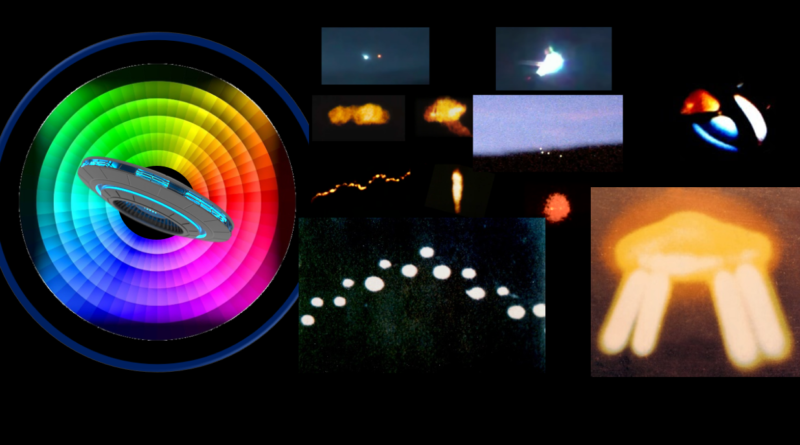
THE COLORS OF UFO LIGHTS IN ARGENTINA (note 2)
“If we were only talking about yellowish lights, some would talk about plasma. But when you observe several lights connected to a moving black object, or to disc-shaped objects, it’s hard to believe that plasma has anything to do with it. I don’t think this theory accounts for a large part of the observations.” (Prof. Erling Strand – Hessdalen Project)
This article was NOT generated using AI (artificial intelligence), except for some images. All of our material was created from statistical data and files.
Thanks to Dr. Mark Rodheguier for his encouragement in helping us complete this work.
INTRODUCTION
Continuing with the previous work “The lights and colors in UFO landings in Argentina”, comes the second part, referring exclusively to the colors. (QUOTE 1)
Descriptions of the colors observed in UFOs are a fascinating aspect.
There is very little information on the subject, and all of it comes from the work of a few international researchers.
It was necessary to contribute the Argentine perspective for the first time, so almost two years ago I decided to dedicate myself to it.
We have carried out a comprehensive analysis of national case studies on UFO colors. The process has lasted almost two years, as I mentioned, with the study of nearly 900 cases out of the 2,000 landings reported in Argentina.
All this effort also allows for exchange with foreign researchers with whom we maintain contact and will open new avenues of study. Furthermore, it is the basis for the approach we are taking in the Binational Project «Southern Cross UFO».
The analysis includes cases of electromagnetic, physiological, and animal effects, as well as effects on the terrain and events at low altitudes or on the ground, and at relatively short distances. These events are known as «Type 1 Phenomena» or «landings» (although they are not strictly objects that landed). In Hynek’s category, we refer to events of the second and third type, and to more complex cases.
The sample is sufficiently representative for the analysis, and we can also study the possible relationship or influence of the lights observed in UFOs on different key variables. Their effects and proximity to the witness make them more important than simple sightings.

In our 50 years of activity in this field, the landing catalog took 30 uninterrupted years to compile, and there is no other like it. Besides its chronological order, it features a complete process of collection, classification, and constant updating. With it, we have been analyzing countless variables, as we have access to all the available raw material.
While there are still great secrets to be revealed in ufology, and areas where no one has made progress, conducting statistical studies that last months or even years allows us to better understand the phenomenon.
Some popularizers belittle statistical studies. They are the promoters of failure, laziness, and ufological «communism,» and they need this narrative to equate everything, given their inability to work with data.
Those of us who do work with data now have more information on aspects that were previously considered «unexplored.»
Therefore, there is no excuse to hide behind the idea that «we can’t make any more progress on the subject.» It’s necessary to seek out information, and not just in specific events or media coverage. Those of us who aren’t satisfied with that defensive rhetoric have been working on it for months, even years. And that always bears fruit, as we’ll see.

(Image Helen, Silvy on Pixabay)
BASIC WORKING PREMISE
Do the colors observed by witnesses in UFOs correspond to any particular colors?
Do some colors correspond to specific maneuvers they perform?
Are the lights seen in UFO tracking and pursuits the same as those found on suspended or perched bodies?
Are there color patterns that affect witnesses, animals, and footprints?
What is the incidence of physiological effects such as paralysis, vision impairment, or burns in these events?
And what about the luminous colors detected in cases of electromagnetic effects?
Do the studies of UFO colors in Argentina coincide with those detected in different countries?
These and other questions are what generated the interest in carrying out this pioneering work.
As Professor James McCampbell points out in his excellent treatise «Ufology,» the descriptions given by witnesses on this subject are very varied. In the description of UFO luminosity, there are terms that can lead to confusion, such as: “silver,” “bright,” “blinding,” “shining,” etc. This also occurs with the colors observed in many UFO cases.

(C. Ferguson Archive)
In the description of the events we study, there is a poorly defined area when describing sequential or simultaneous colors (as McCampbell already discussed), or even compact beams of light.
There are eyewitness accounts that allow us to determine that, during a certain maneuver, the luminosity observed on the surface of the UFO varied sequentially.
Some concepts can be confusing not only for witnesses, but also due to the addition or omission of information by some media outlets, or even by pseudo-researchers and those who disseminate scoops. The latter is predictable, since most «experts» and popularizers don’t consider the matter important (we’ve even heard some say that «knowing the color of a UFO won’t help us determine its origin and isn’t relevant»). In our case, we prefer to ignore such nonsense and delve as deeply as possible into the issue.
For all of this, genuine research and data collection are key, distinguishing it from journalistic accounts or those of occasional YouTubers, fond of endless theories.
The descriptions of witnesses include the vast majority of colors in the spectrum.
The sequence of events in each case also plays a role: clearly, in many of them, the brightness is associated with the maneuvers and/or speeds that the objects exhibit.
In other cases, we found that UFOs not only appear to produce light effects as a result of maneuvers, but also carry what seem to be «navigation» lights (steady or flashing). Some are located on their upper surface, others on the underside, or around their perimeter.
To this must be added the compact beams (which can originate from objects and entities).
All of this is a factor for present and future analysis (this article only presents the general characteristics).
In this initial study, we begin by taking the first step, aiming for comparison with international information.

THE SAMPLE
From the largest catalog of landings to date, with 2,000 events, we first selected those with some luminous description (excluding ambiguous descriptions and solid-appearing objects, preferably daytime).
We found 1,192 cases of UFOs accompanied by lights.
Unfortunately, in 318 of these cases, we have no data whatsoever on the color of the luminescence (we have examined hundreds of sources but found none).
Therefore, the total number of UFO landing cases in Argentina with color data from 1947 to the present is 874 (and since we have some cases with more than one UFO of a different color, the final total is 887).
These 887 descriptions constitute a sufficiently representative and comprehensive sample for analysis.
In his important work, “UFO Reports Involving Vehicle Interference” (QUOTE 2), Dr. Mark Rodeghier states the following:
“Whenever possible, classification was done using the witnesses’ own words. If two or more colors were reported in a UFO, both were recorded separately. No distinction was made between large, bright color sources and small, dark sources. Only primary colors were used in the coding. In many cases, the colors came from light sources within the UFO, not from the actual color of the UFO’s surface (except in metallic cases).” (end of quote)
Following similar lines of analysis, I have differentiated the colors according to 5 items:
Events with 1 color
Events with 2 colors
Events with 3 colors
Events with 4 colors
Multicolor events (all events where more than 4 colors were reported fall into this category).
The analysis of all these events was based on more than 30 variables, namely:
Maneuvers (flight – hovering – perched – ascent – approach – retreat – descent – tracking)
Duration
Distance
Shapes (disc – oval – sphere – elongated – others)
Diameters
Secondary light beam
Traces
Underwater cases
Physiological effects (sound – sight – paralysis – burns – unconsciousness – heat – teleportation – smell – cutaneous effects – pain)
Electromagnetic EM effects
Effects on animals
Weather
Time
Some analyses were also performed combining two or three variables to try to determine possible patterns in the lights.
The scope of this work is vast, and what we will mention here is only the first step in the analysis of this fascinating phenomenon.

STUDY PROCESS
The study process was conducted taking into account the aforementioned values over almost two years with uninterrupted daily dedication.
After studying each of the colors (1, 2, 3, 4, and multicolor), preliminary conclusions were drawn, considering the colors and separating them precisely.
For example: when we have more than one defined color (2, 3, or 4), the analysis was performed by separating each color.
In this way, we have the complete studies in two forms (specific and general).
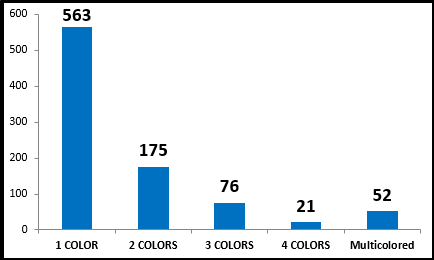
The results are:
Events with 1 color = 563
Events with 2 colors = 175
Events with 3 colors = 76
Events with 4 colors = 21
Multicolor events = 52
Let’s briefly analyze what this information and data show us.
PREDOMINANCE: UFO APPEARANCE IN ARGENTINA
When we talk about the term “UFO/lights,” the first association that usually comes to mind is that the entire surface of the object is light. This has also been abused by detractors to simplify luminous cases as conventional confusions.
Of the total of 887 descriptions, 481 correspond to objects reported as “all light.” The remaining 406 are descriptions that we have decided to categorize as “structural objects with lights.”
Here we had a presumption: a body defined as “ALL LIGHT” is likely due to the “Witness Distance” factor (as we know, this is related to visual perception and the physics of light at great distances or apparent magnitude: any body that possesses some luminosity in its structure, at a relatively great distance, will be observed with an appearance of complete luminosity).
Through elementary sources, we know that:
“An object with point lights (such as navigation lights) scatters and merges its brightness, which, combined with atmospheric attenuation, causes the brain to interpret separate points of light as a single luminous form. Distance reduces the eye’s resolution, causing small light sources to appear as a single luminous body.” (end of quote)
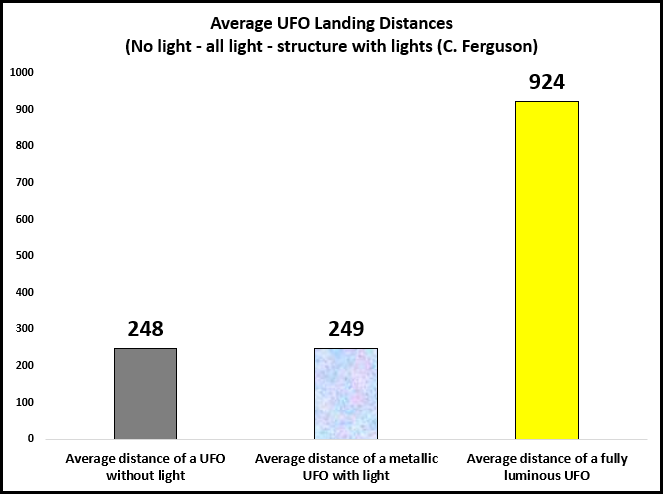
To confirm our hypothesis, we took all the luminosity cases that contained distance data. And we separated the events defined as “All light” from those of “Structures with lights.”
The results largely confirmed what we suspected, and they are conclusive:
Events reported as «all light» have an average distance of 924 meters, while those described as «structures with light» average 249 meters (a figure almost identical to that of solid objects without light or «daytime discs,» which are at 248 meters).
This shows that the average distance of «all light» UFOs is almost four times greater than the others, which is to be expected in this type of description. A luminous body at such a distance is highly likely to be described by witnesses as a «body of light,» without noticing any detail on its surface.
(C,Ferguson Archive)
COLORS
Only a portion of the light we receive is visible, with white being a combination of all the primary colors. Several factors clearly influence color perception: the surrounding area (law of simultaneous contrast), the observer’s degree of adaptation to the light intensity, color memory, among others.
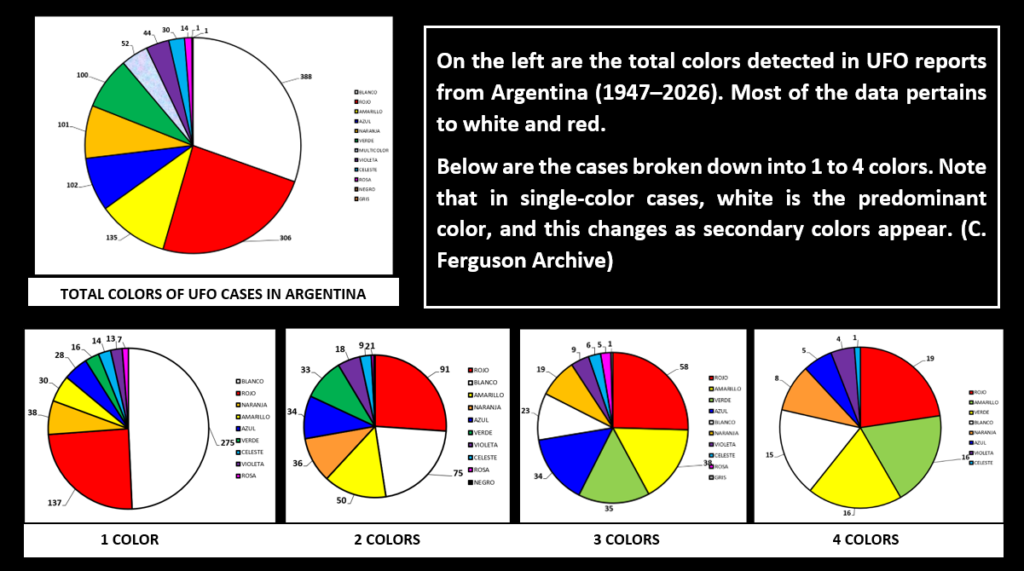
In most of the items analyzed in the Argentine case studies, two colors predominate: white and red (both individually and when broken down).
An additional, very interesting element to analyze is what happens with the colors that follow in order of proportion (the «third» or «fourth» colors can reveal some striking characteristics).
Therefore, in this color report, we will discuss «general analysis» and «specific analysis» (in some cases).
UFO COLORS AND MANEUVERS IN ARGENTINA
In analyzing UFO maneuvers, we might find a relationship between certain colors and the actions the UFO performs.
To determine this, we must calculate the maneuvers performed in all cases where we have luminous objects with detailed colors.
We have differentiated them as follows:
Flight = 395
Hovering = 158
Landing = 50
Ascent / Movement Away = 70
Approach = 76
Descent = 91
Tracking = 47
In the global UFO case study, there are countless instances where UFOs undergo sequential color changes during certain maneuvers.
Dr. McCampbell had already pointed out in his excellent research, citing Aimé Michel, that colors seem to be associated in some way with speed, or more likely with acceleration speed.
“Silvery gray with a dark red halo is seen when the object is stationary or traveling very slowly. Then comes bright red; at high acceleration, white, green, blue, and purple appear.” (QUOTE 3)
And Mc Campbell adds:
“Very little progress has been made in understanding this relationship. Each instance of sequential color change was associated with accelerations and the energy state model. However difficult it may be, this association seems to make this puzzling aspect of UFOs more significant. This correlation is of vital importance as it establishes a relationship between the UFO propulsion system and the stimulation of atmospheric gases for light emission. Certainly, a great deal of work is needed in this area, and a thorough analysis of the best-documented cases by a theoretical spectroscopist should highlight this.” (end of quote)
In the complete data of the Landing Case Studies in Argentina, we see in the following graph the percentages of all maneuvers in all the analyzed colors:
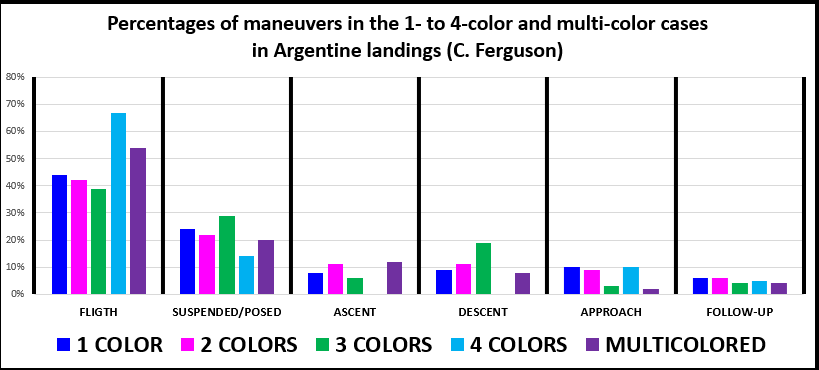
We note that most witnesses see UFOs in flight, so it’s logical that there are more cases there.
Analyzing the data separately (from one to four colors, plus the multicolored ones, 5 in total), we see the following graph:
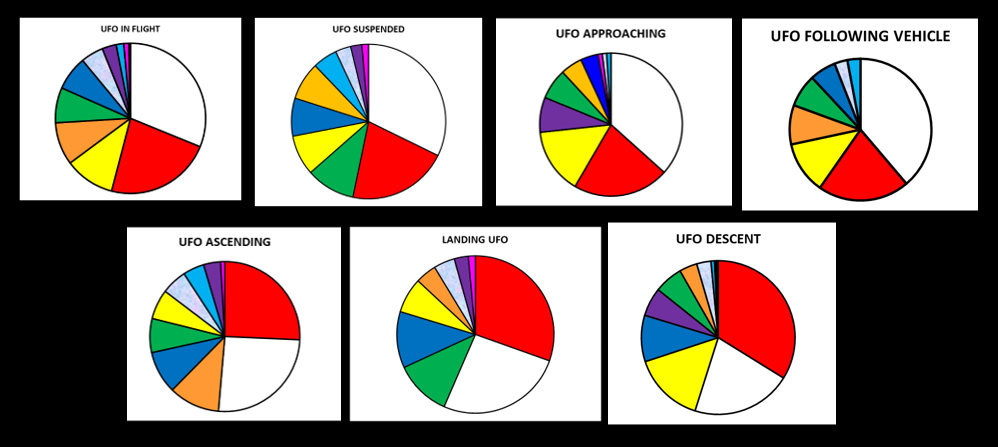
We clearly observed that over 50% of the total colors correspond to white and red.
And another piece of information emerged from the statistical analysis: the color white is predominantly associated with flights, hovering objects, approaches, and tracking.
In contrast, the color red (the second most prevalent) is primarily associated with objects at rest, ascents, and descents (see graphs below).
In agreement with Dr. McCampbell, the technical implications of the white glow suggest some type of electrical phenomenon, with:
a) A large, negative potential relative to the ground causing electrons to leak into the atmosphere;
b) an alternating potential agitating the gas atoms in its vicinity; or
c) an internal alternating current acting as an antenna to radiate energy into the atmosphere.
We have begun specific studies for each of these items, which will be key to their results.

OTHER VARIABLES ANALYZED IN ARGENTINA’S UFO COLORS
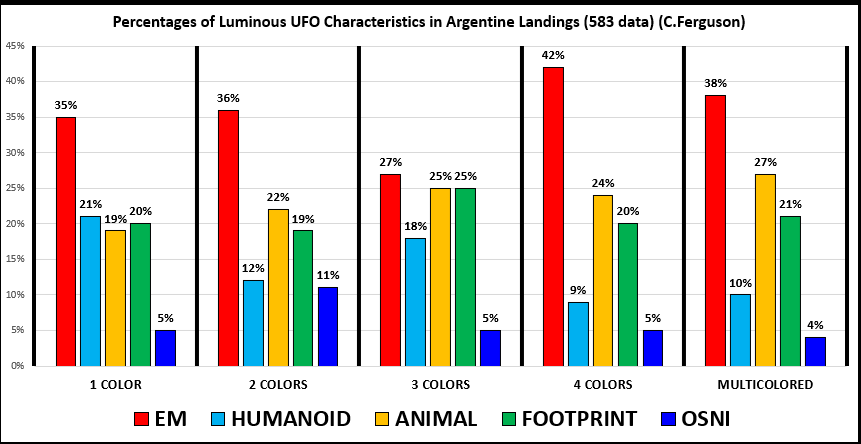
The other variables analyzed focused on electromagnetic (EM) effects, footprints, humanoid sightings, effects on animals, and underwater objects.
The following graph shows the percentages of 1 to 4 colors and multicolored cases, based on these characteristics:
UFO COLORS AND PHYSIOLOGICAL EFFECTS
“My advice is to be careful of noisy, domed discs with bluish-white beams of light, because if you encounter one, you are likely to experience at least some physiological effects.” (Dr. Donald Johnson)
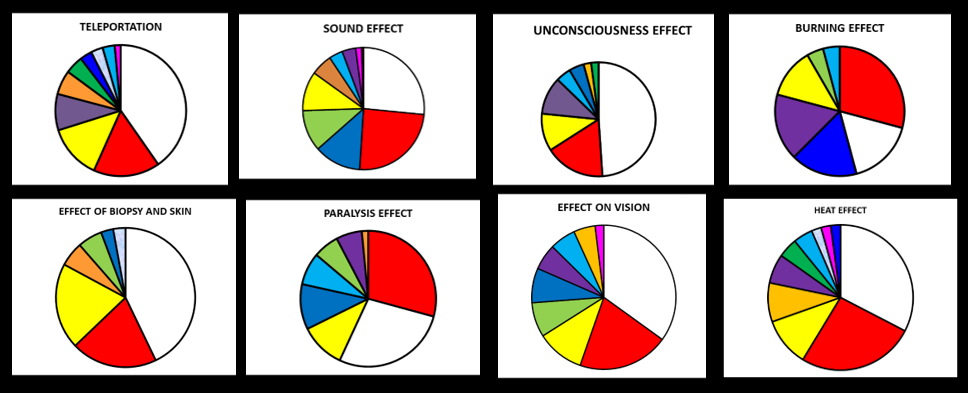
Below are the percentages of colors associated with these effects. Since sound is the most prevalent effect, it accounts for the largest share:
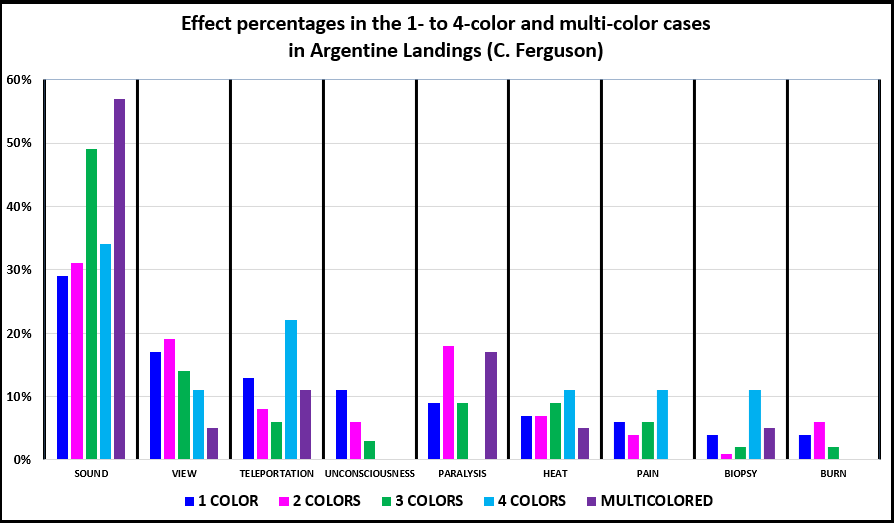
This study also allows us to uncover a striking aspect that we can announce today: there are the strange and controversial cases of teleportation (sometimes accompanied by a sensation of lost time and/or abduction).
Most experts estimate these events at no more than 20 or 30, but they are mistaken: the Argentine record already exceeds 110 episodes.
Returning to the point, in these cases, two specific luminosities are generally present: yellow-violet colors, especially when witnesses report being «enveloped» in light (when there are close approaches to vehicles on roads), or moments before losing consciousness (I will address these cases in detail in another study shortly, now that we have all the comprehensive information from Argentina).

Finally, regarding cases of physiological effects, I have already noted that in the overall tally where witnesses report lights of specific colors (and considering them individually), we find a predominance of white, followed by red.
But in these physiological cases, the burn effects on witnesses make red the predominant color.
UFO COLORS IN STUDIES ON TIME, DURATION AND DISTANCE
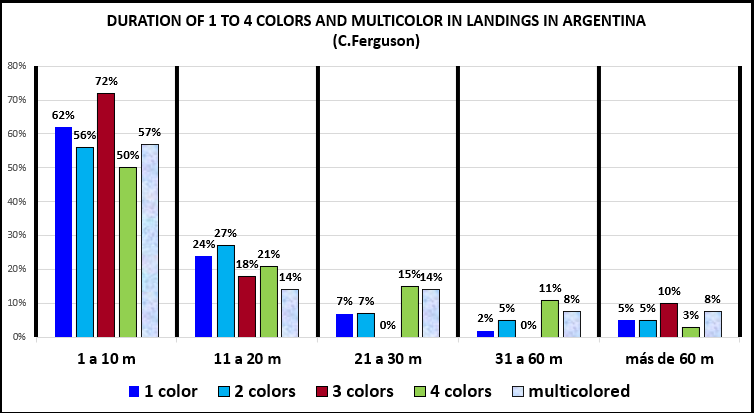
In the percentages regarding duration there are common details, which are typical of the UFO duration range in general:
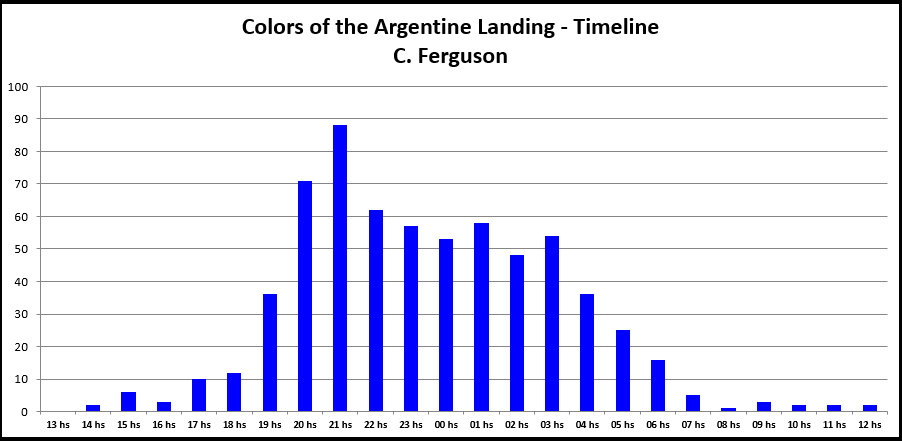
Regarding the time, international and local patterns also apply, with 9 pm as a constant:
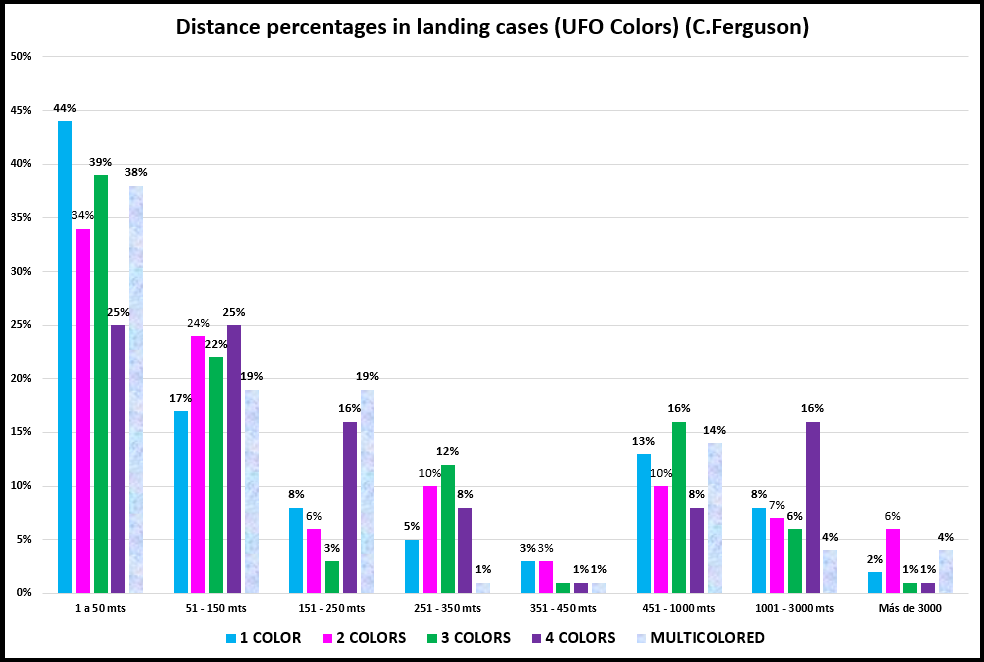
The distance to the witnesses maintains the common average values, with events decreasing from 450 meters onwards, with a second peak from there towards 3,000 meters:
UFO COLORS AND THE SHAPES AND DIAMETERS OF THE OBJECTS
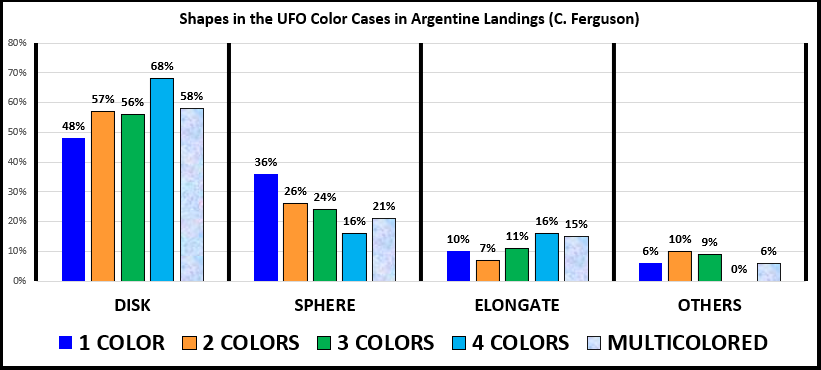
In the following graphic we can see the shapes reported in cases of 1 to 4 colors and multicolored objects:
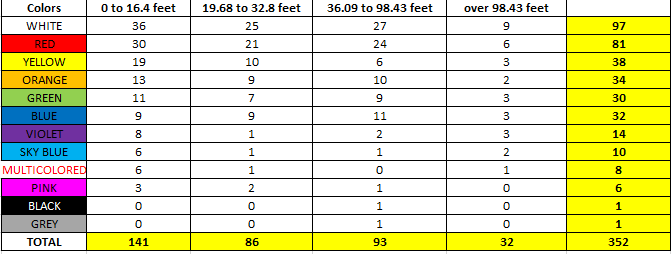
Regarding diameters, we have defined ranges from 0 to 16.4 feet, from 19.68 to 32.8 feet, from 36.09 to 98.43 feet, and over 98.43 feet. All colors within each range are detailed.
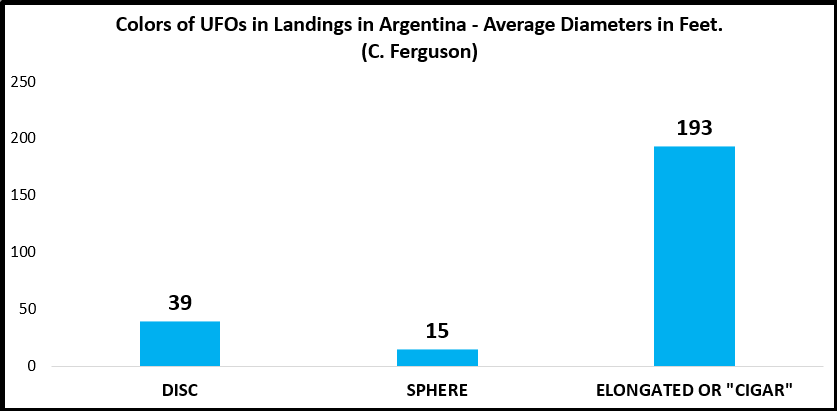
We conducted a further study using the average diameters and shapes of UFOs. It is very interesting to note that the averages meet international standards: the «discs» measure an average of 39 feet, the spheres 15 feet, and the elongated objects or «cigars» 193 feet.
UFO COLORS IN SIMULTANEOUS AND SEQUENTIAL LIGHTS
According to Dr. James McCampbell’s study, we have the categories of simultaneous and sequential lights.
Simultaneous lights occur when the UFO emits several lights at the same time (for example: a light on top of one color and perimeter lights of different colors).

(C.Ferguson Archive – Pixabay Image)
According to McCampbell, these cases “may indicate a highly selective mechanism for stimulating light emission, probably originating from noble gases. The horizontal arrangement of the bands on an axially symmetrical object may reflect geometric characteristics that would alter or distort the electromagnetic fields in its vicinity” (end of quote).
As for sequential lights, these are those where we can find colors in response to certain maneuvers performed by UFOs (mainly acceleration maneuvers).
McCampbell believes that this correlation “is of vital importance since it establishes a relationship between the UFO propulsion system and the stimulation of atmospheric gases for light emission.”
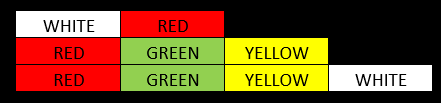
In my work, simultaneous flashes occurred 256 times, while sequential flashes occurred 56 times. There is very interesting data to study here, as we were able to discover some trends in each.
For example: in simultaneous flashes, the trends are white and red (out of 140 binary data points), red, green, and yellow (out of 58 tricolor data points), and red, green, yellow, and white (out of 15 quadricolor data points).
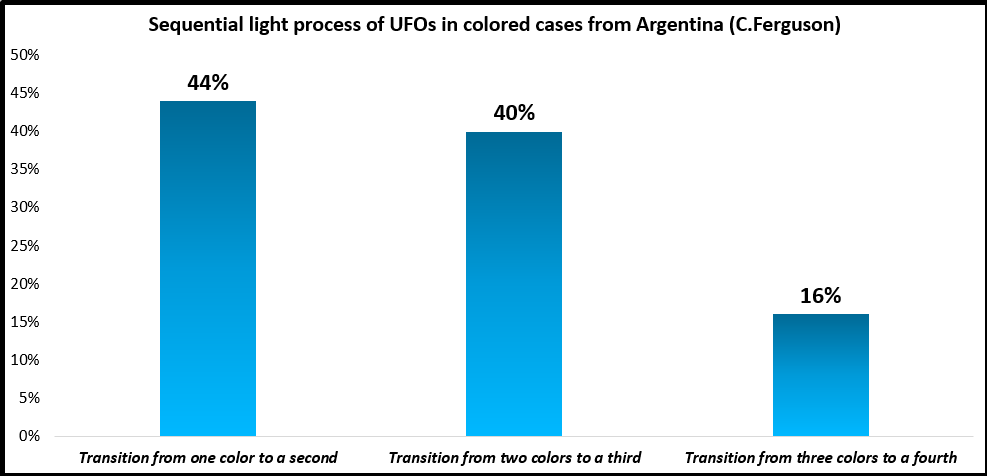
Regarding sequential flashes, there are interesting combinations that we will analyze later, but we can summarize them as transitions from one color to another (44%), another proportion of transitions from two colors to a third (40%), and to a lesser extent, transitions from three colors to a fourth or color changes in four sequences (16%).
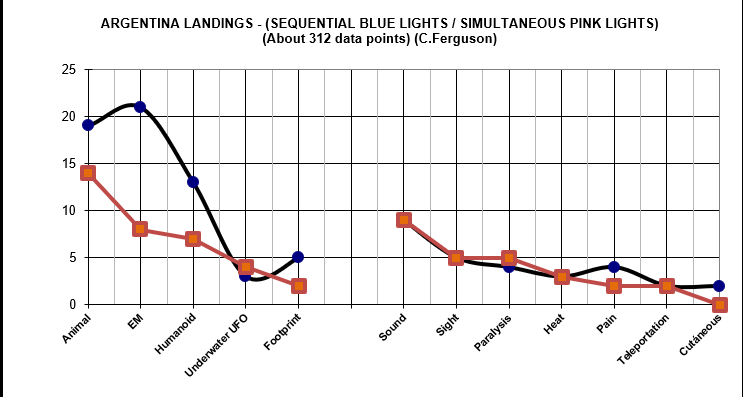
I was able to carry out additional work on these aspects, which is essential when one wants to examine all the data: to see if there were any trends in simultaneous or sequential flashes across different variables (maneuvers, effects on witnesses, and others). The study doesn’t seem to reveal anything beyond the standard percentages. Most maneuvers involve flights.
Regarding certain UFO characteristics (left of the graph) or physiological characteristics (right), there also doesn’t appear to be any trend other than the average percentages we have. Only the last item (cutaneous effect and/or burns) doesn’t occur with simultaneous lights, but the number of events is so small that we can’t draw any conclusions about it. It’s crucial to continue studying these variables (sequential and simultaneous), in relation to others, especially those involving maneuvers, various effects, etc.
UFO COLORS IN LIGHT BEAMS
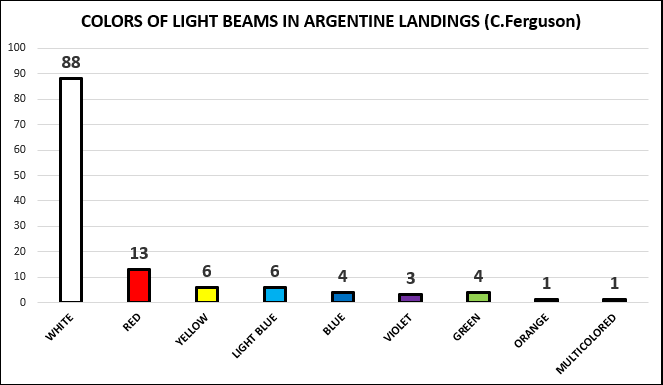
Compact light beams are another variant that the phenomenon exhibits in certain cases. We will analyze this topic exclusively later, but to add information to our study, we have 130 events where this has occurred. We are talking about a laser-like beam that seems to scrutinize objects, or in some cases (not only from UFOs but also when controlled by humanoid figures), it performs a task of deterring or repelling. Sometimes it seems to command other objects with various signals.

(C. Ferguson Archive).
In his excellent work entitled “UFO Reports Involving Interference with Vehicles” (1981), Dr. Mark Rodeghier analyzes light beams in terms of their presence, pursuit, control, and physiological effect.
Regarding the physiological aspect, Rodeghier mentions that “in almost half of the events involving a light beam, the witness was affected.”
In our study in Argentina, the percentage is almost the same (44%).
John Schuessler also addressed the topic in 1997 in his work on the physiological effects on UFO witnesses.
Analyst Simon Harvey-Wilson, in his work «UFO Phases and Beams of Light,» highlights the dramatic episode of Collares Island in Brazil (1977), noting that the beams appeared to be:
«…always sharply defined, directed with perfect precision toward any target: houses, people, boats, trees, even the Brazilian Air Force helicopters deployed over the island during the UFO wave investigations.»
By November 1977, the doctor in charge of the health unit on Collares Island, Dr. Wellaide Cecim Carvalho de Oliveira, «had seen no fewer than thirty-five patients claiming injuries to the face or chest area.» These injuries, which resembled radiation injuries, «began with intense reddening of the skin in the affected area. Subsequently, the hair fell out and the skin turned black. There was no pain, only a slight warmth. He also noticed small puncture marks on the skin. The victims were men and women of different ages, with no apparent pattern.» (end of quote)
Dr. Vallée was the researcher who traveled to the site and was able to conduct studies that he has documented in his publications.

His conclusion is that «what UFO witnesses describe as ‘light’ may, in fact, be a complex combination of ionizing and non-ionizing radiation. Many of the injuries described in Brazil, however, are consistent with the effects of high-power pulsed microwaves.»
He adds that pulsed microwaves can «interfere with the central nervous system. Such a beam could cause the dizziness, headaches, paralysis, tingling, and numbness reported by so many witnesses.»
We will soon delve into a specific study of this topic. (C.Ferguson Archive)
UFO COLORS AND SMELLS
Dr. James McCampbell addressed this topic years ago.
He emphasized:
“While it may seem far-fetched to ask if UFOs have any smell, it would be particularly significant if witnesses had detected the same gases produced by electrical discharges in direct association with them. The smell of lightning is generally described as pungent and repugnant, similar to ozone, burnt sulfur, or nitric oxide.”
The reference to sulfur is easily understood, as this element is a notorious air pollutant from automobile exhaust and industrial plant smoke. Even in rural areas, the sulfur content of the air can be quite high due to its production by bacteria in swamp mud and the bottoms of lakes and streams.
In any case, this evidence is an independent source of information pointing to an electrical disturbance on the surface of UFOs that is undoubtedly associated with their luminosity.” It is clear that the smells reported in UFO events are precisely those that would be expected from chemical reactions. in the atmosphere caused by electrical discharges or microwave radiation.” (end of quote)
In my study, only 15 cases contain any description of an odor (1.6%). Of these, 10 contain a description of sulfur, and the remaining 5 contain the following descriptions: “gas” – “damp paper” – “hot oil” – “burnt grass” – “burnt electrical conduit.”
McCampbell estimates that microwave energy would be involved in these events and adds:
“A similar oxidation of atmospheric sulfur to sulfur dioxide could well be responsible for the commonly reported sulfur odors.” (end of quote)
Unfortunately, the duration of these cases is only mentioned in four of them. However, this duration far exceeds that of any natural phenomenon (we are talking about 617 minutes for the four cases combined). One final detail about the odors (which we will expand upon in depth, as with the other variants): we have three cases where bad weather conditions are mentioned. In one of them, a luminous sphere (November of The 2009 earthquake could suggest the presence of an electrical phenomenon. However, its apparent diameter (4 meters) and the duration of the event rule out this possibility.
Regarding the other two (October 1963 in Córdoba and September 1967 in Santa Fe), we have descriptions of metallic structural objects and also extended durations.

(C. Ferguson Archive) (Images combined from Pixabay)
UFO COLORS AND BASIC CLIMATIC CONDITIONS
Of the 874 cases, 20 involved adverse weather conditions (storm, rain).
This analysis was further supplemented by studying these 20 cases to determine the possible influence of natural phenomena.
Regarding appearance, the overwhelming majority of descriptions depicted objects with a structure (metallic appearance and lights, windows, etc.).
Regarding duration, it was sufficiently long to attribute it to natural phenomena. The duration in these 20 cases averaged 548 minutes, implying an average of 27 minutes per observation.
Once again, the combination of details (appearance and duration) allows us to draw these conclusions.
The colors detected in the adverse weather conditions did not differ from those observed in favorable weather conditions.
SOME CONJECTURES
In UFO sightings, we find all the colors of the rainbow spectrum.
In his excellent work on this subject, Dr. James McCampbell mentions cases where witnesses report a glow or halo of mist, and points out that the source of the UFO’s light is not the object itself but the surrounding air.
He adds:
«It is clear that these examples of gaseous luminescence depend on high temperature, the emission of photons from the most abundant gases, and the mixing of numerous spectral lines to produce white light.»
Regarding colors, Mc Campbell mentions:
“Xenon is strongly suspected to be responsible for the ‘blue’ reported in the sample cases. Xenon’s identity as the source seems almost certain because no other neutral gas in the atmosphere emits photons of a medium blue color. (QUOTE 4)
Its temperature could be around 8,000 K (bluish-white).
The ‘orange-red’ or ‘fire-red’ so frequently seen near UFOs can probably be attributed to the bright orange-red of neon, 6402 A 0, which is so easily recognized in neon signs. (QUOTE 5)

Its temperature may be around 3,000 K.
The combination of the green line of neon, 5401 A 0, with the blue of xenon would produce the frequently reported ‘blue-green’ or it may come from hydrogen, 4861 A 0.
«Purple» would result from the blue of xenon and the red of… Argon, 6965 A 0.
Although these claims are certainly not proven, they tentatively suggest a plausible explanation for the variety of colors emitted by UFOs.
It is observed, with minor exceptions, that the most likely candidates for color emission are helium, neon, argon, krypton, and xenon. It is precisely these noble gases that are preferred for use in gas lasers.
It would appear that the blinding light emitted by UFOs is not associated with extremely high temperatures. Otherwise, the thermal expansion of the gases would produce a terrifying roar, like a continuous lightning bolt. (end of quote)
In September and October of 1997, the so-called «Sturrock Panel» was convened to analyze «Physical Evidence Related to UFO Reports.» It was organized by the renowned British-American physicist Peter Sturrock.
He was a Professor of Applied Physics at Stanford University, dedicating much of his career to astrophysics, plasma physics, solar physics, and the UFO phenomenon.

The Sturrock Panel (held in New York) included great scientists and researchers, among them Prof. Peter Sturrock, Francois Louange, Richard Haines, Mark Rodeghier, J. Schuessler, Erling Strand, J.J. Velasco and Jacques Vallée.

In their conclusions regarding the lighting aspect, they noted:
“The human eye is a very poor device for measuring absolute brightness: the eye’s state of dark adaptation affects the amount of light that reaches the retina, and different parts of the retina respond differently to light. Furthermore, previous brightness estimates were apparently based on the assumption of isotropic emission. (Isotropic emission describes a type of radiation or emission that is distributed uniformly in all directions of space, as if it came from a central point source.
In simple terms, isotropic emission is the same everywhere, no matter the direction from which it is viewed or measured.) This may be a reasonable assumption for a natural phenomenon, but it could be inappropriate for a technological device.
For example, aircraft landing lights are highly anisotropic. Moreover, distance estimates can be quite dubious. Therefore, the power estimates derived for the above cases should be considered rather uncertain. The most promising cases will be those in Those where some type of physical interference occurred (such as an effect on a public lighting system) require detailed investigation by specialists familiar with such systems.” (end of quote)
To obtain reliable quantitative estimates of the phenomenon’s luminosity, Dr. Jacques Vallée summarized data from six cases of unexplained aerial phenomena reported by qualified observers in order to estimate the optical power output. Vallée’s estimates range from a few kilowatts to many megawatts.
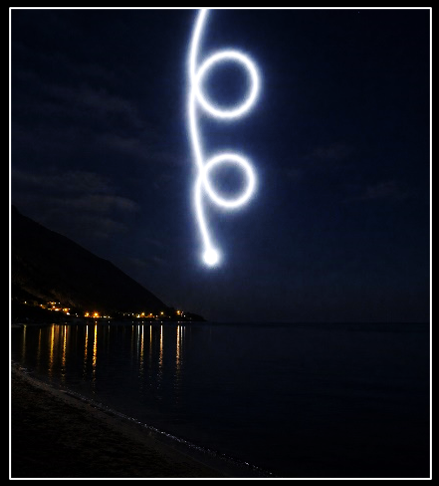
As we noted in Part 1 (previous article), one of the most significant events presented by Dr. Vallée occurred in late September 1965 in Fort-de-France, Martinique. Personnel from two French submarines and crew members of a supply ship (more than 300 witnesses) were able to observe, in good weather conditions, a large, luminous, white, spherical object that approached slowly from the west, flew south, described two complete circles in the sky above the ships, and vanished like a light bulb rapidly switching off. Based on the witnesses’ descriptions, Vallée estimated the object’s luminosity to be on the order of 2 megawatts.
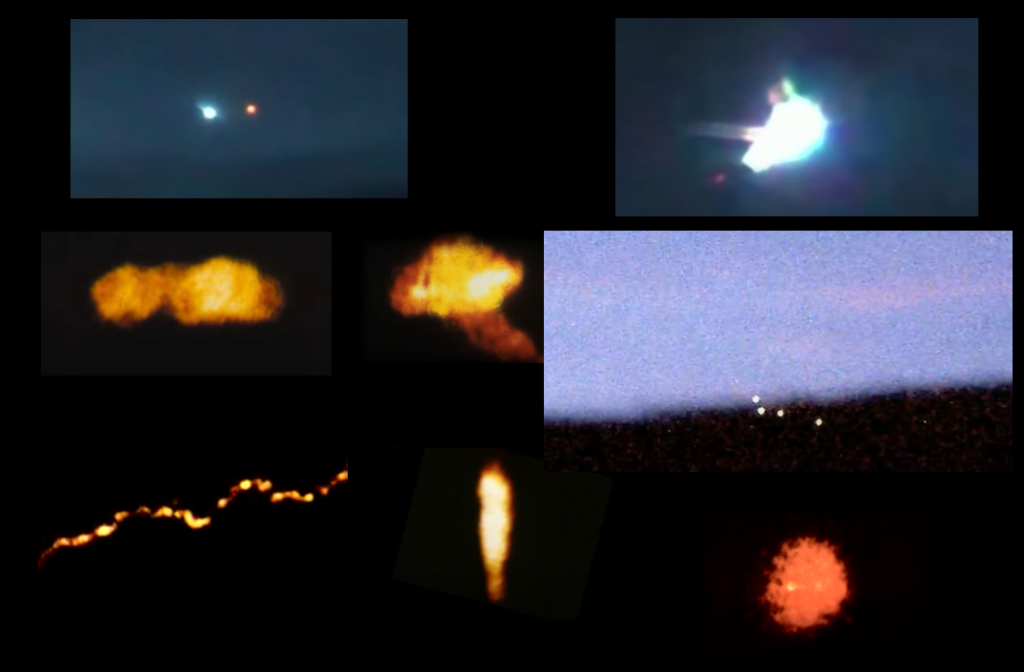
Regarding the notable Hessdalen Project (Norway), the prominent scientist Erling Strand was also present at the 1997 «Sturrock» meetings. He has been directing the Hessdalen Project, using optical instruments since 1981. His studies have detected a wide variety of UFOs with different colors. Based on all of them, three different categories were established:
Type 1: a yellow “bullet” with the pointed end facing downwards.
Type 2: A strong blue-white light, sometimes flashing, always in motion.
Type 3: a pattern comprising many light sources of different colors that moved as if physically connected.
CONCLUSION
The luminous component of UFOs and their colors encompass a significant number of variables to be analyzed.
As we already mentioned, a major difficulty is often the lack of certain concrete descriptions due to shortcomings or omissions in journalistic surveys or ufological publications.
Be that as it may, we still have a crucial wealth of data and are a step beyond the repeated case reports and sensationalist «scoops.» And this is just the beginning…
Undoubtedly, possessing catalogs of this magnitude implies a significant dedication of time and effort, but it takes us to another level of research, far removed from the magical answers and solutions of the lazy.
By studying every detail of the phenomenon in this way, we are advancing into unknown or never-before-explored territories.
The study of the colors observed on the surface of UFOs is key to determining many factors or discarding others. While they don’t allow us to define the origin or «transcendent truths» of the phenomenon, there is no way to investigate a topic without addressing details of its conduct and behavior, as well as its evident manifestations, except in those that are only found in anecdotal accounts.
The exchange of data and researchers at the international level is just beginning, but we aim to be able to expand the information further with those who are working at other levels and seriously on the issue.
This database is in addition to the quiet and methodical work that has been carried out by the Binational Southern Cross UFO Project, from the continent to the world. (QUOTE 6)
Since its creation, we have taken a fundamental step that only now do some seem to recognize. The important thing is to be pioneers in the times to come, which will hold many activities for us….
Carlos Ferguson
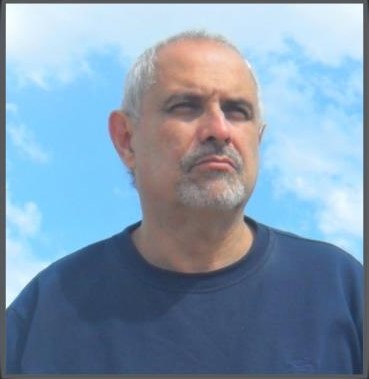
Author Carlos Ferguson works in the education and administration sectors, is an art teacher, and has dedicated himself to UFO research for 50 years, ever since, as a skeptic, he had a close encounter with a disc-shaped UFO at a distance of no more than 35 meters. He was the first civilian UFO consultant for the Argentine Air Force (2011-2017). He has completed courses in satellite technology, remote sensing, and geographic information systems. He is the author of seven books and the largest compilation of UFO landing cases in Argentina, including classified events. He has also conducted studies on pilot and UFO cases in Argentina, as well as on underwater objects and, more recently, on the physiological and electromagnetic effects on witnesses. Hundreds of talks and articles over nearly five decades demonstrate that his work is rigorously researched and statistically sound. He dedicates himself to daily statistical work but is currently completely removed from the ufological community, maintaining only a few selective contacts.
QUOTE
QUOTE 1: “The lights and colors in UFO landings in Argentina” (part 1)
QUOTE 2: Dr. Mark Rodeghier, “UFO Reports Involving Vehicle Interference” – 1981, Center for UFO Studies, Chicago.
https://cufos.org/PDFs/books/UFO_REPORTS_INVOLVING_VEHICLE_INTERFERENCE.pdf
QUOTE 3: Michel, Aime, “The Truth About Flying Saucers,” p. 143, Pyramid, 1967.
QUOTE 4: Xenon is a noble, colorless, odorless, and heavy gas found in the atmosphere in small quantities. It is known for its applications in lighting, such as xenon lamps, but is also used in medicine as an anesthetic and neuroprotective agent, and in the nuclear industry. (Xenon lamps for automobile headlights, film projectors, theatrical lighting, and applications requiring bright, concentrated light) (Wikipedia)
QUOTE 5: Neon is a colorless, practically inert noble gas, present in trace amounts in the air but very abundant in the universe. It imparts a characteristic reddish hue to the light of fluorescent lamps in which it is used. The reddish-orange tone of the light emitted by neon tubes is widely used for advertising signs. (Wikipedia)
QUOTE 6: The binational project «Southern Cross UFO» was launched in 2024 after three years of preparation and is carried out from Uruguay and Argentina. In addition to the largest qualified database, it includes a research project and the establishment of the first permanent station for recording UFO sightings in all of Latin America. Its objectives are: to develop and promote field and theoretical studies and research from South America related to UFO reports; to generate a joint archive and statistical analysis of binational case studies; and to establish permanent stations for recording UFO sightings, among others. It is a private initiative and does not receive support or funding from any government agency. The work is ongoing and avoids sensationalist media coverage and the pursuit of media scoops.