

LIGHTS AND COLORS IN UFO LANDINGS IN ARGENTINA (Note 1)
By CARLOS FERGUSON
INTRODUCTION
In a close encounter with UFOs, we can encounter two basic visual alternatives.
The first is an object called a “daytime disc,” or a solid-looking body.
The second is a luminous body or “night light.” Generally observed from a distance, only a small percentage exhibit truly anomalous characteristics, and the vast majority are mistaken for natural or artificial phenomena.
But there is another alternative: a solid-looking body with lights.
From a distance, it appears as a completely luminous point. But if either party (UFO or observer) approaches, the latter begins to notice that what was seen as “all light” is now a solid-looking structure with openings through which one or more powerful lights can be seen. Once the witness’s account is known—if not thoroughly analyzed—it can end up as sensationalist stories or those of «UFO experts» who downplay the details.
The case will be labeled as a «luminous UFO» (without any description of the lights, whether they were continuous or sequential).
The final link in the communication chain may be a detractor who—taking advantage of this lack of data—will try to dismiss the case as an «unidentified light.»
This sequence leaves the case with a regrettable lack of information.
Sometimes that data is lost forever.
In this work, we will demonstrate statistically that it is no longer acceptable to define UFOs as «luminous» and «non-luminous.» After decades of careful study, the descriptions point to a clear category, which we will explain.

PROLOGUE
“There are no miracles. Those who lack the courage to make the effort to gather the data shouldn’t expect the solution to fall from the sky. Let all those interested in the problem begin searching; their searches will not be in vain. If no one contributes their small stone, the building will likely remain at the foundation stage.” (European quote from a 1970s article on the search for data on UFO lights)
This excellent quote suggests that:
A – In Ufology, there is no data without searching for it (“miracles”)
B – To gather this data, courage is necessary (to fight against the rush to be first, charlatans, sensationalism, and time)
C – The most extensive and thoroughly researched documentary archive is the raw material.
The topic of the colors of UFO lights has not been the subject of abundant literature, except for a few cases, and almost none of them are in Spanish.
Analyzing the nearly 2,000 UFO landing cases in Argentina (1947-2025), the largest and only Argentine catalog with a rating system, we can now process countless studies never before conducted in our national archive.
We are undertaking another pioneering project in our country, this time related to light and color.
We have already been analyzing all of these landing cases in studies on physiological and electromagnetic (EM) effects, and others regarding the UFO-witness distance relationship, etc.
In this first article, we will examine structural objects with lights. In part two (which we will publish shortly), we will cover, for the first time in Argentina, the details of UFO light colors.
For many popularizers and pseudo-researchers, this type of analysis does not lead us to the secrets of the phenomenon (we have even heard some say that if a UFO has two or three colors, it will not clarify anything about its origin). Such positions reveal a striking level of limitation and ignorance.
They are the ones who start from the end, elaborating theory after theory that only leaves open questions without analyzing the complete UFO raw material. Pure pseudo-philosophical narrative without data, laden with «mystery,» which only seeks to shock listeners or deceive themselves.
As we always say: in this matter, no one has the absolute truth, but those of us who have the data and sacrificed ourselves and had the courage to seek it, are a little closer to the truth and a little further from the sensationalist buzz surrounding these scoops.
Unlike those who reject data, we believe it is indispensable, because it is impossible to speak of «constants» of the phenomenon without examining all the variables it presents. To undertake this study, it is essential to examine the few outstanding studies that have been conducted worldwide, such as those by scientists Mark Rodeghier, James McCampbell, Jacques Vallée, Simon Harvey-Wilson, Donald Johnson, Dr. Willy Smith, or those contributed by the Sturrock Commission and the Hessdalen Project, to name a few (as we have noted, none of them are Spanish-speaking). From all of these studies, we have already drawn some key conclusions that we will explore in this analysis.

LIGHTS IN THE UFO PHENOMENON
“At night, they are visible primarily by self-generated light and only secondarily by reflection, and virtually all colors of the spectrum are reported, with a color change often observed as the UFO accelerates.” (Dr. Joseph Allen Hynek)
The pioneering researcher Dr. Joseph Allen Hynek already defined a striking characteristic of the phenomenon in 1953 in a presentation at Ohio State University: he spoke of “Night Serpentine Lights.”
We are talking about the sighting of a bright, star-like light, perhaps of stellar magnitude -2 or -3, that hovers silently, inverts its field without appearing to rotate, and often accelerates abruptly. The light is most often described as amber-yellow or orange, occasionally changing to blue or red, and noticeably changing in brightness.
Sometimes the description says that the light went out as if someone had pressed a button; In other instances, the light is reported only as a variable. A very characteristic statement from those who make the reports is: «I’ve never seen anything like this in my entire life.» The desire to identify these sightings as balloons is thwarted by the observed tactics.

Dr. Hynek’s right-hand man for years was the physicist Dr. Willy Smith, who also wrote an essay entitled «Why Do UFOs Have Lights?» (QUOTE 1).
In it, he stated that UFO lights can be «essential» or «optional.» The former would be those associated with the operation of the craft, its propulsion or power source, and always present when the craft is in flight.
In his conclusions, Smith noted:
“Based on observational evidence, it appears that the lights of UFOs are not essential to their operation, even though changes in the lights at certain times are apparently connected to abrupt and slow accelerations. UFOs—like any sophisticated device—do not need visual contact with the environment; they maneuver to avoid pursuers and obstacles. This leaves us with the alternative that the operators may be using other lights so that they can be seen when visibility suits their purposes, whatever those may be. This option is disturbing, as it apparently rules out the hypothesis of a rare but natural phenomenon.” (end of quote)

The phenomenon also seems to show signs of reciprocal action in response to certain light stimuli.
Another characteristic of the lights involves the famous compact beams, which possess astonishing properties, passing through objects, striking, generating heat or burns, etc. “It could be interpreted that the intentionality and behavior demonstrated by the “coherent beams” is primarily observational in nature, with a specific function outside of remote inspection.” (QUOTE 2)
Be that as it may, on some occasions, UFO lights have responded to light signals from witnesses.
But we also have countless cases where the emitted light has generated a multitude of physiological effects in witnesses, animals, and the ground.
Some of these events (such as those in Brazil in the 1970s investigated by Dr. Jacques Vallée) are truly disturbing and raise countless questions when evaluating this topic.
We probably owe this to light radiation (high-frequency radiation, generating heat and burns) or ionizing radiation (gamma, alpha, or beta rays).

(Photo: The events in Brazil in 1977)
We are undoubtedly facing an alteration of our physical and psychological environment, with subsequent consequences.
One striking case is the aggressive light response. There are numerous instances where witnesses—motivated by fear or terror—are about to commit a hostile act.
It is quite surprising that the phenomenon seems to «pre-interpret» such intentions and carry out a retaliatory action that—fortunately, in most cases—has not had disastrous consequences.
All of this points to a technology with impressive capabilities (and this has been happening for decades).

THE LIGHTS IN HESSDALEN
In the Norwegian town where UFO sightings have been recorded since the 1980s, there is the best location for capturing the phenomenon, thanks to the expertise of Electronic Engineer and Master of Science, Erling Strand.
As is the case everywhere, many of these sightings have been attributed to misunderstandings. However, a remnant or core of sightings remains, which infuriates the detractors in a significant number of cases.
Some have returned to the «plasma» method to try to eliminate the remaining evidence.
The truth is that countless cases of UFOs with powerful luminosities, but also dark objects, have been reported in Hessdalen. As the pioneer Oscar Uriondo aptly points out:
“The phenomenon sometimes appears as a ‘bullet,’ with its pointed end facing downwards; other times as a ‘Christmas tree’ with many multicolored light sources that moved as if physically connected; also as very intense, often flashing, bluish-white lights, always in motion. In observations in broad daylight, the phenomena appeared as dark objects, oval or rectangular in shape, sometimes cigar-shaped, and also as discs.” (QUOTE 3)
In some of the anomalous cases of lights, radar detected a body moving at 30,000 km/h.


UFOs AND PLASMA?
And since we’ve mentioned plasmas, at the Canadian Institute of Aeronautics and Space Astronautics Symposium (Montreal, March 12, 1968), Professor James MacDonald addressed the topic, stating:
“Earlier in my analysis of the UFO problem, my colleagues raised the question of whether UFOs might be an unknown form of plasmoid. But the kind of UFO reports that are provocative are not mere balls of light, but structured objects described by apparently quite credible witnesses as if they were machines of some kind. My most fundamental objection to your plasma-UFO theory is that it fails to address the fact that interesting UFO reports do not involve nebulous, bright, amorphous masses, but rather seemingly sharp objects that often exhibit discernible structural details, carry discrete lights or porthole-like openings, and maneuver for periods of time and in kinematic patterns that are extremely difficult to reconcile with your plasma-UFO hypothesis.” Nor does it quantitatively address parts of the argument that, according to existing scientific knowledge, are susceptible to quantitative analysis.
Philip Klass (an American aviation and aerospace journalist) has developed his position (in favor of plasma UFOs) in two articles and a recently published book. Klass suggests not only that aircraft can attract plasma UFOs, but also that cars attract them at low altitudes.
However, there are hundreds of cases that could not even remotely be reconciled with Klass’s plasma-UFO hypothesis on any reasonable scientific basis.

The main points of criticism of Klass’s plasma UFO theory are as follows:
1. He does not include figures in his hypotheses when they are easily inserted.
2. Plasmas are notoriously unstable and evanescent, except when properly contained and provided with sustainable energy sources.
3. Through a series of rather surprising misunderstandings, Klass constructs a thesis according to which air pollutants are favorable to plasma UFOs. The formation of plasma, and from this, he makes repeated deductions of an exorbitant nature, such as the greater incidence of UFOs at high altitudes due to more jets contaminating the respiratory tract.
4. Lacking an understanding of the elementary principles of atmospheric electricity, he constructs a chain of errors that runs from the diurnal variation of the atmospheric electrical potential gradient to the diurnal variation of UFOs, and from this he deduces an «explanation» for the excess of rural over urban sightings.
5. His claim to have explained the high frequency with which pilots observe UFOs following aircraft completely collapses when the idea is subjected to quantitative evaluation” (QUOTE 4)
Among others.
It has been a long time since Dr. MacDonald debunked Klass’s speculations. Today we know more about many electrical phenomena, but the basic considerations held by MacDonald have not changed.
Plasmas are ionized gases that exhibit electrical phenomena such as electrical conduction, response to electromagnetic fields, and light emission, making them the source of natural phenomena like lightning and auroras, and technologies like plasma lamps.
Flying electrical phenomena include St. Elmo’s Fire (a visible glow on sharp objects during storms), static electricity on aircraft that generates flashes, lightning (high-power electrical discharges), etc.

However, when analyzing UFO cases exhaustively, these phenomena can only explain a very small percentage of cases. It is striking that, in their mania for wanting to be «original» or generate «scoops,» some «ufologists,» «experts,» or «popularizers» rush to put forward hypotheses as if they were already proven «truths,» without having the complete statistical background.
Thus, they will casually refer to many UFO cases as «plasmas» without considering or examining two key factors: the duration of the event, the distance to the witness, and the fact that the studies should be limited to regional areas.
In their speculations, they fail to realize that many witnesses describe luminous masses at significant distances, and that—as this distance decreases—we are dealing with structures containing lights. The structured objects to which MacDonald refers are part of the key, and we will analyze them below, in the context of Argentine UFO landing cases.

UFOs WITH LIGHTS
It’s no secret that there are many ways observers can be deceived by lights in the night sky, with countless phenomena.
In my analysis, cases of confusion with natural and artificial phenomena have a specific section (which we will analyze shortly in another article). From what remains, we know that one of the main characteristics of the phenomenon is the powerful, striking, and specific luminosity present in most cases.
We’re talking about lights that seem to «illuminate everything as if it were daytime» in the middle of the night, apparent position lights, pulsating lights, etc.
In the study conducted by the Sturrock Panel (QUOTE 5), Dr. Jacques Vallée summarized six aerial cases to obtain reliable quantitative estimates of the phenomenon’s luminosity.
Vallée’s estimates range from a few kilowatts to many megawatts.
And given that the phenomenon is essentially nocturnal (as Vallée himself has demonstrated with the Law of the Hour), it is quite logical that most UFO sightings include descriptions of lights.
The first phase of the work consisted of compiling data on reports of UFO landings with and without lights.
This, like the rest of the study, required a very precise search for several reasons.
The generalization of «luminous» and «non-luminous» is fundamental.
In principle, in UFO accounts (both from the press and from interested parties, including some ufologists), we find very specific deficiencies, with insufficient information.
There are many accounts that do not specify whether the UFO’s luminosity was complete or partial, or worse still: we have nocturnal cases in which nothing is mentioned (neither luminosity nor color).
Surprisingly, this occurs not only with the press but also with some self-proclaimed «experts» on UFOs, demonstrating that some overlook certain data because they don’t consider it «shocking» or because it «doesn’t resolve the origin of the phenomenon,» which constitutes a notable inconsistency.

In my work on UFO landings in Argentina, a preliminary study determined that, out of 1,341 cases, 1,192 were described as «luminous objects» (89%) and 149 as «objects without light» (11%).
But the definition of «luminous object» is insufficient. It was necessary to delve deeper into the information to eliminate as many ambiguities as possible.
We already know that the usual detractors claim that we are dealing with a large number of cases, mainly of «unidentified lights,» and a smaller number (the non-luminous ones), which could also be misunderstandings, beliefs, or hoaxes.
Those who make such claims have never bothered to refine their search for case descriptions.
But while theorists stroke their beards in cafes, speculate on social media with outlandish interpretations, or misreport old cases with fragmented information, we prefer the long and patient work of delving into the data.
Years of work are now bearing fruit.
After reviewing the sources thousands of times, we can now find some aspects where the information changes completely.

THE THIRD VARIANT: THE STRUCTURE WITH LIGHTS
The dichotomy between “luminous” and “non-luminous” (which is generally defined as “night light” or “day disc”) only very broadly encompasses the issue.
Because we can also have luminous objects during the day and night objects that—without possessing any light—were still detected indirectly (roadlights, streetlights, or others).
But the surprise came when analyzing the information from each case more thoroughly.
There, the third variant, already described by MacDonald, appears: objects with structures and lights.
The intermediate step between the solid-appearing object without light and the fully illuminated one is a structure with lights.
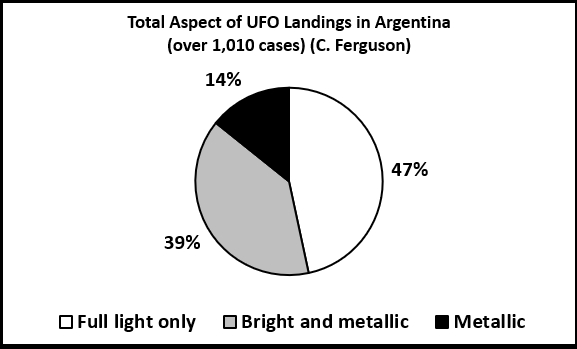
Here, the result detailed above changes completely.

(C. Ferguson)
What do we call structures with lights?
The evidence is clear: we have perimeter lights, upper lights on turrets or hatches, lower lights in openings, beams of light emitted from different angles, etc.
The witness sees that behind the light (whatever its nature), there is a description of an «apparatus,» or a «metallic-looking structure,» «dark» or «solid,» with lights. This is very different from the expression «all light.»
As we will see in the graphic below, although most cases are still nocturnal, we now have more elements to place UFOs within the range of physical phenomena.
DISTANCES AND LIGHTS
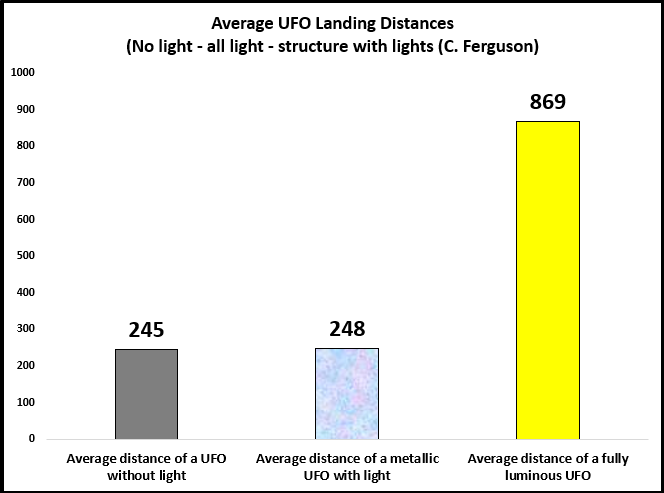
As part of the study of UFO appearance descriptions, we can now add another key piece of information: we were wondering about the average distances in the three cases mentioned above: UFOs without light, UFOs described as «all light,» and metallic-looking objects or structures with light. We have this information for 442 cases.
And this author also assumed that the UFOs described as «All Light» could likely be due to a distance factor. Methodical statistical analysis confirmed this.
In the cases of UFOs without light and structures with light, the average distance to the witness is almost the same (245 and 248 meters, respectively).
But the situation changes radically with objects defined as «All Light,» where that distance extends to 935 meters.
This allows us to confirm some basic points:
A – Logic tells us that the vast majority of UFO descriptions defined by witnesses as “all light” (or complete light, without seeing any further details) occur because the distance to the witnesses prevents them from seeing more structural details. This is basic, but it was necessary to corroborate it with statistics.
B – The opposite occurs when witnesses are closer to the UFO, where descriptions of lights with structures abound.
Unfortunately, the press in general (and some ufologists who promote mysteries and popularize them) have not delved into these details.
Thus, in a case where a light appears within a larger structure – sometimes solid or metallic in appearance – they usually refer to it as a “luminous UFO” or “Plasma UFO,” without exploring the data further.
It happens that in many events, witnesses were seeing an object defined as “all light” at a great distance, and when the distance decreased, they were then able to discover the structural details. Just mentioning a few events is enough to illustrate this:
Case 1 = August 12, 1974: Villa Huidobro (Córdoba) 8:45 PM: Mrs. Haydé Wurm observed a luminous object hovering at a low altitude, 500 meters from her house. Moments later, it began to approach and within 3 minutes was 10 meters from her position. The formerly luminous object was now a spherical shape, 80 centimeters in diameter, pale yellow in color, and solid in appearance. The light did not illuminate the surrounding area. After 25 minutes, it began to move away. There were other witnesses to the event, and effects were observed on animals.
Case 2 = August 16, 1996: La Negra, near Tandil (Buenos Aires) 4:40 AM: Rural worker J.L.P. observed a luminous object at a distance later estimated at 3,400 meters (based on landmarks in the mountains). It had flashes of green, yellow, and red light. As the witness was driving to work in his pickup truck, he closed the distance to the object. When it was 500 meters away, the details of what he observed changed: now, in front of him, was a domed, metallic-looking object with lights. The object followed the truck for about 6 kilometers, finally moving away to the west. Traces remained on the ground where the UFO had hovered.
Case 3 = April 25, 1996: Mar del Plata and surrounding area (Buenos Aires Province) 7:00 PM: Hundreds of witnesses observed luminous objects in the airspace, even from Tandil. Therefore, the distances were very great, and no details of the structure were visible. However, three witnesses in the area near Mar del Plata were able to witness the initial part of the phenomenon: when it was close to the ground and at a short distance. The observers (one of them an engineer) were inspecting the streetlights in the «La Armonía» area when the engine of their vehicle suddenly stopped. At the same time, they saw a dark, disc-shaped object rise from a hill about 200 meters away. It displayed a series of white lights around its perimeter, which seemed to move across its structure. It remained visible for about a minute, during which time a stampede occurred among the cattle in the nearby field. During this time, it was seen by a farmhand a couple of kilometers from the initial location. And then by many more, by then as a luminous object.
These three cases serve as examples to confirm that distance is often a key factor in discerning more details in an object described as «all light» in ufology.

CONCLUSIONS
A – In close-range events, witnesses report lights of varying intensity at different points on the object’s structure. These include perimeter lights, sequential lights, lights from above or below, front or rear lights, and downward beams of light illuminating the ground or various objects (including people), etc.
B – Apparently, and corroborating the study conducted on thousands of cases by Dr. Willy Smith, UFO lights are not essential for their movement, although changes in the lights at certain times seem to be related to abrupt and slow accelerations. According to engineer James McCampbell, the luminosity corresponds to the ionization of atmospheric gases. Other unresolved aspects of the lights emitted by UFO structures cannot be ruled out. Compact beams of light (which we will address in another work) possess surprising characteristics: they penetrate objects, impact them, generate heat or burns, etc.
C – Responses involving the exchange of light signals have been reported on some occasions. In some cases, the UFO responded with another signal or approached the witness(es) in a perceptible manner. Negative interactions or responses have also occurred in some cases, with disastrous consequences for some observers, involving apparent high-frequency or ionizing light radiation (gamma, alpha, or beta rays). Furthermore, as a general rule, everything seems to support the premise proposed by Lic. Ángel Díaz in his Psychodimensional Hypothesis, which refers to the point of «Limited Contact» (anomalous presence, superiority, with the least possible damage).
D – Plasma-type cases explain only a very small percentage of close encounters. However, as Dr. McDonald pointed out, this presents several disadvantages, ranging from the duration of the encounter to the description of structures with lights.
E – Witness descriptions of «illuminations as if it were daytime» demonstrate the striking power of the phenomenon, which has always been present. They cannot compare it to anything known, and this is one of the strangest aspects of the phenomenon.
F – At this point, it is unacceptable to limit the classification to “luminous” and “non-luminous” cases. Therefore, it is essential to delve into the details that many “UFO experts” and the press overlook. We are referring to structural details, which constitute a significant number of reports (39%). These are sometimes omitted for various reasons (intentional or due to lack of interest).
G – Statistics on UFO reports defined as “fully luminous” correspond to the greatest distance from other objects (daytime or with a structure).
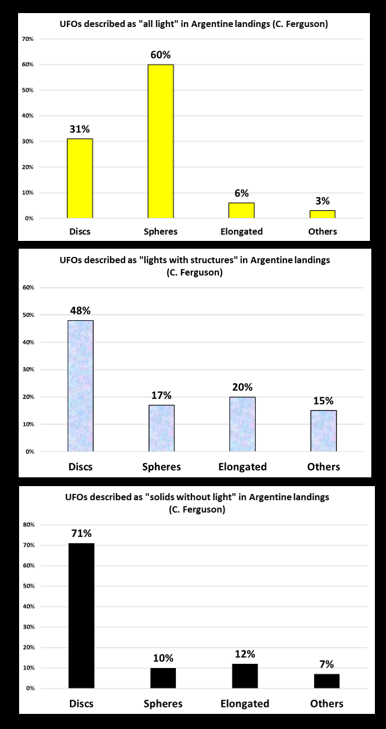
Regarding their appearance, descriptions of “fully luminous” objects primarily refer to luminous spheres. Their average diameter is smaller than that of the other categories, but larger than that of possible natural phenomena.
We have also conducted a study on the shapes of UFOs. In the three graphs below, we found that the cases defined as ALL LIGHT are the only ones that predominantly exhibit spherical shapes (as would be expected of any luminous body at a relatively large distance). This does not imply ruling out spheroidal objects, which are numerous in our history and are generally described as «probes» emanating from larger bodies.
The history of UFO research in Argentina is rich in information, but it was necessary to corroborate it through decades of work, which we have carried out in the largest statistical study on UFO landings (without the collaboration of the vast majority of participating ufologists).
H – In cases where witnesses observe the UFO at a great distance and then at a shorter distance (due to the approach of one of the participants), important structural details begin to be observed. It is interesting to note that, in these cases (had such an approach not occurred), they would have remained «all illuminated.» Unfortunately, there are many events in which the distance between the UFO and the witness is not great, but due to shortcomings in the investigation and data that some media outlets do not prioritize, this information has been lost.
I – Participants in the UFO phenomenon (promoters, detractors, and even «UFO experts») often omit data and case studies, leading to greater confusion and a lack of methodical analysis of factors such as duration and distance. In a study conducted in the 1990s at conferences of the RAO (Argentine Network of Ufology), we demonstrated an alarming 45% inaccuracies and omissions in researchers’ reports. This also occurs in descriptions of luminous objects, where terms like «brightness,» «flash,» «reflection,» etc., are often used imprecisely. The same problem arises with colors, which we will address in the next article.

EPILOGUE
“If you have the answer beforehand, it’s not research!” (Dr. Joseph Allen Hynek)
Every aspect we can examine regarding the UFO phenomenon will never be in vain.
And any attempt to get closer to the goal cannot be done by skipping steps or simply sharing stories in casual conversation.
UFO luminosity holds fascinating aspects that reveal a particularity of the phenomenon that is out of the ordinary.
Argentine case studies are rich in material, but the vast majority of those who talk about it don’t even have 20% of the cases, so their conclusions are completely biased and erroneous. To the laziness and cowardice of that majority in undertaking the investigation, we try to be an alternative through systematic, careful, and laborious compilation, which took us decades.
The fruit of all this can be seen today in each conclusion.
In the next issue, we will present the preliminary conclusions on UFO colors, which has already required 15 months of compilation, an unprecedented work in Argentina.
CARLOS FERGUSON
Partial or total reproduction is prohibited without the express authorization of the author.
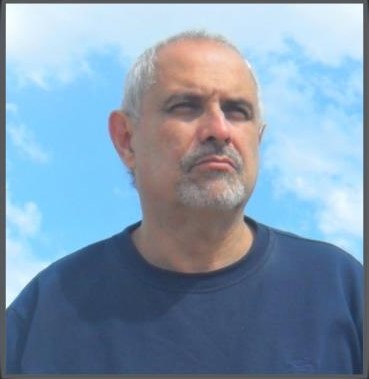
Author Carlos Ferguson works in the education sector in the Province of Buenos Aires, Argentina. He is also a professor of art and has dedicated himself to UFO research for 48 years, ever since, as a skeptic, he had a close encounter with a disc-shaped UFO at a distance of no more than 35 meters. He was the first civilian UFO consultant for the Argentine Air Force (2011-2017). He has completed courses in satellite technology, remote sensing, and geographic information systems. He is the author of seven books and the largest compilation of UFO landing cases in Argentina, including classified events. He has also conducted studies on pilot and UFO cases in Argentina, as well as underwater objects, and more recently, on the physiological and electromagnetic effects on witnesses. Hundreds of talks and articles over nearly five decades demonstrate his consistent approach to research, adhering to statistical parameters. He is dedicated to daily statistical work, but is now completely outside the environment of ufological participants, maintaining some selective contacts.
QUOTES
QUOTE 1: Why Do UFOs Have Lights? – Dr. Willy Smith – Sky Bulletin No. 1 – 1993
QUOTE 2: Occult Topics, UFO Phenomenon – Electromagnetic Effects – Volume 1, p. 118 – Spain, 1982
QUOTE 3: “UFO Anomaly” – Oscar Uriondo – Dunken Publishing – pp. 165–167 – Buenos Aires, 2006
QUOTE 4: “UFOs: An International Scientific Problem” – Prof. James MacDonald – Paper presented at the Astronautics Symposium of the Canadian Institute of Aeronautics and Space, Montreal, Canada, March 12, 1968
http://www.project1947.com/articles/casia_68.htm
QUOTE 5: “Physical Evidence Related to UFO Reports”: Proceedings of a workshop held at the Pocantico Conference Center, Tarrytown, New York, September 29–October 4, 1997